On April 9, 2026, Hugging Face officially elevated Kernels to a first-class repository type on the Hub — joining Models, Datasets, and Spaces as a top-level primitive. The huggingface_hub v1.10.0 release added programmatic support for creating, managing, and downloading kernel repos, cementing an ecosystem that has been quietly growing since mid-2025 into a core part of the platform.
Intermediate
Key points
- On April 9, 2026, Hugging Face officially elevated Kernels to a first-class repository type on the Hub, joining Models, Datasets and Spaces as a top-level primitive.
- The huggingface_hub v1.10.0 release added programmatic support for creating, managing and downloading kernel repos, cementing an ecosystem that had been growing since mid-2025 into a core part of the platform.
- A GPU kernel is a low-level function that runs directly on GPU hardware, such as matrix multiplications, attention mechanisms or normalization layers; building FlashAttention from source can require 96 GB of RAM.
- The Kernel Hub launched in June 2025 as a community-driven library, then gained the kernel-builder tool in August 2025 and ROCm support for AMD GPUs (MI300X and beyond) in November 2025.
- Benchmarks show optimized RMSNorm kernels achieving up to 2.47x speedup over PyTorch defaults on H100 GPUs at longer sequence lengths, and Hugging Face’s Text Generation Inference and Transformers already load Hub kernels in production.

What Are Kernels?
In the context of GPU computing, a kernel is a low-level function that runs directly on GPU hardware — operations like matrix multiplications, attention mechanisms, or normalization layers that make up the core compute of AI models. Writing and compiling these kernels has traditionally been one of the most painful parts of ML infrastructure: building FlashAttention from source, for example, can require 96 GB of RAM and hours of compilation.
Hugging Face’s Kernel Hub solves this by letting developers load pre-compiled, optimized kernels with a single function call:
from kernels import get_kernel

# Load FlashAttention — no compilation, no build flags
flash_attn = get_kernel("kernels-community/flash-attn")
The kernels library automatically matches the correct pre-built binary to your Python version, PyTorch version, and CUDA/ROCm version. What used to take hours now takes seconds.
From Library to Platform Primitive
The Kernel Hub launched in June 2025 as a community-driven library. Over the following months, the ecosystem grew rapidly:
- August 2025: The kernel-builder tool launched, giving developers a complete pipeline for writing CUDA kernels, building them with Nix for reproducibility, and publishing to the Hub with semantic versioning.
- November 2025: ROCm support arrived, extending the platform to AMD GPUs (MI300X and beyond) alongside CUDA, Metal, and XPU backends.
- February 2026: Hugging Face released agent skills for CUDA kernel generation, enabling AI coding agents like Claude and Codex to write, benchmark, and publish production-ready kernels.
- April 9, 2026: With
huggingface_hubv1.10.0, kernels became an official repo type with dedicated API methods likekernel_info(),hf_hub_download(), and full lifecycle management.

Why It Matters
The promotion to a first-class repo type signals that kernel sharing is no longer experimental — it is a supported pillar of the Hugging Face platform. Key capabilities include:
- Multi-backend support: CUDA, ROCm, Metal (Apple Silicon), and XPU from a single codebase.
- Semantic versioning and locking: Pin kernel versions in
pyproject.toml, lock dependencies, and convert kernels to Python wheels for air-gapped deployments. - Real-world performance: Benchmarks show optimized RMSNorm kernels achieving up to 2.47x speedup over PyTorch defaults on H100 GPUs at longer sequence lengths, and up to 1.97x at large batch sizes on L4 GPUs.
- Production adoption: Hugging Face’s own Text Generation Inference (TGI) and the Transformers library already load kernels from the Hub in production.
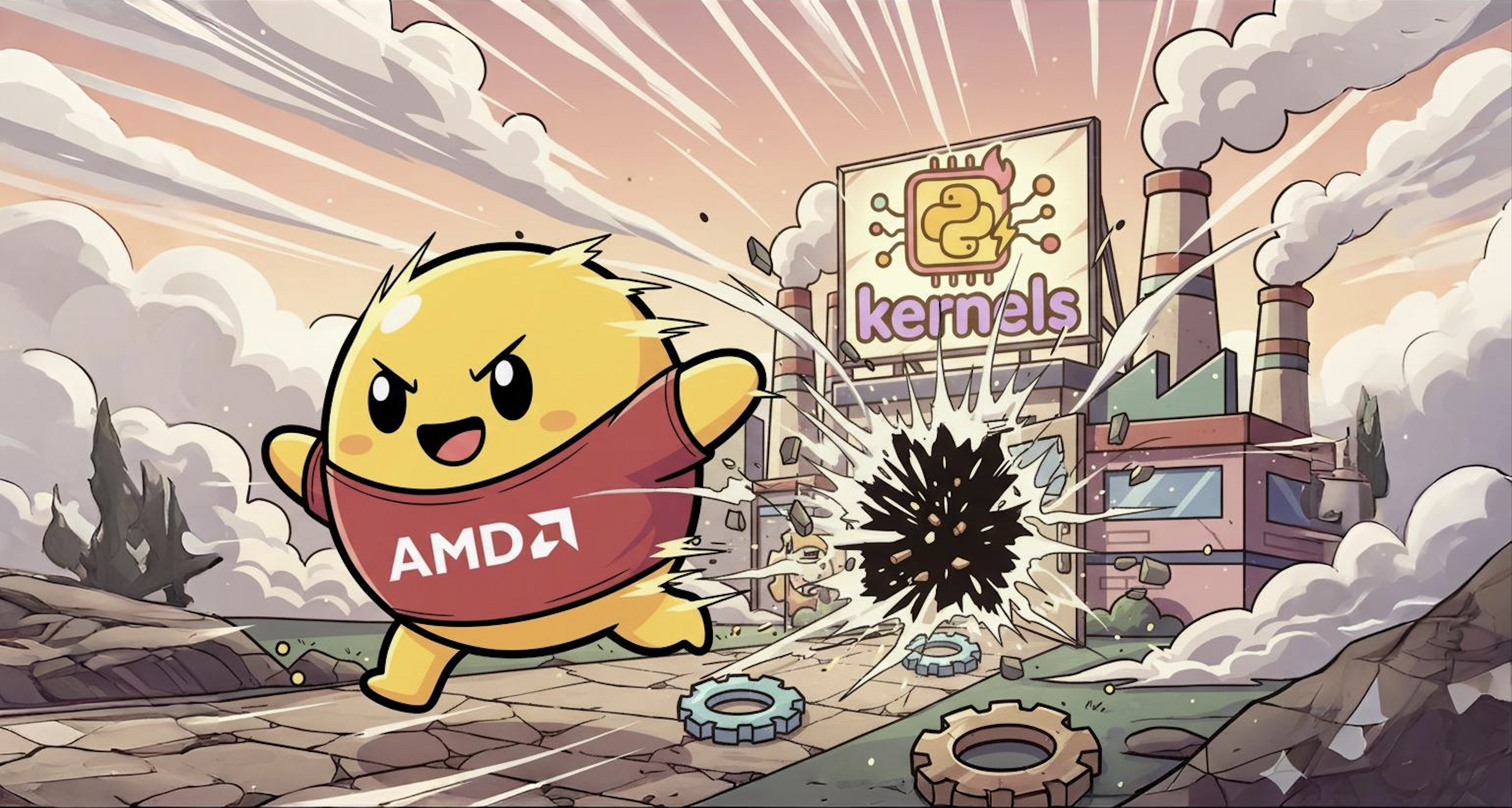
The kernels-community organization on the Hub hosts a growing collection of ready-to-use kernels — FlashAttention, quantization, MoE routing, activation functions, and more — that any project can pull in with a single line of code.
Related Coverage
- Safetensors Joins the PyTorch Foundation as a Vendor-Neutral Standard — another Hugging Face project gaining official platform status
- Introducing Hugging Face’s MCP Server — expanding the Hub’s role as an AI development platform
- FlashAttention-4: Algorithm and Kernel Co-Design for Blackwell GPUs — the kind of kernel optimization that the Kernel Hub aims to democratize
This post was drafted with AI assistance and reviewed by RITS staff.
Leave a Reply