Tag: Level: Advanced
-
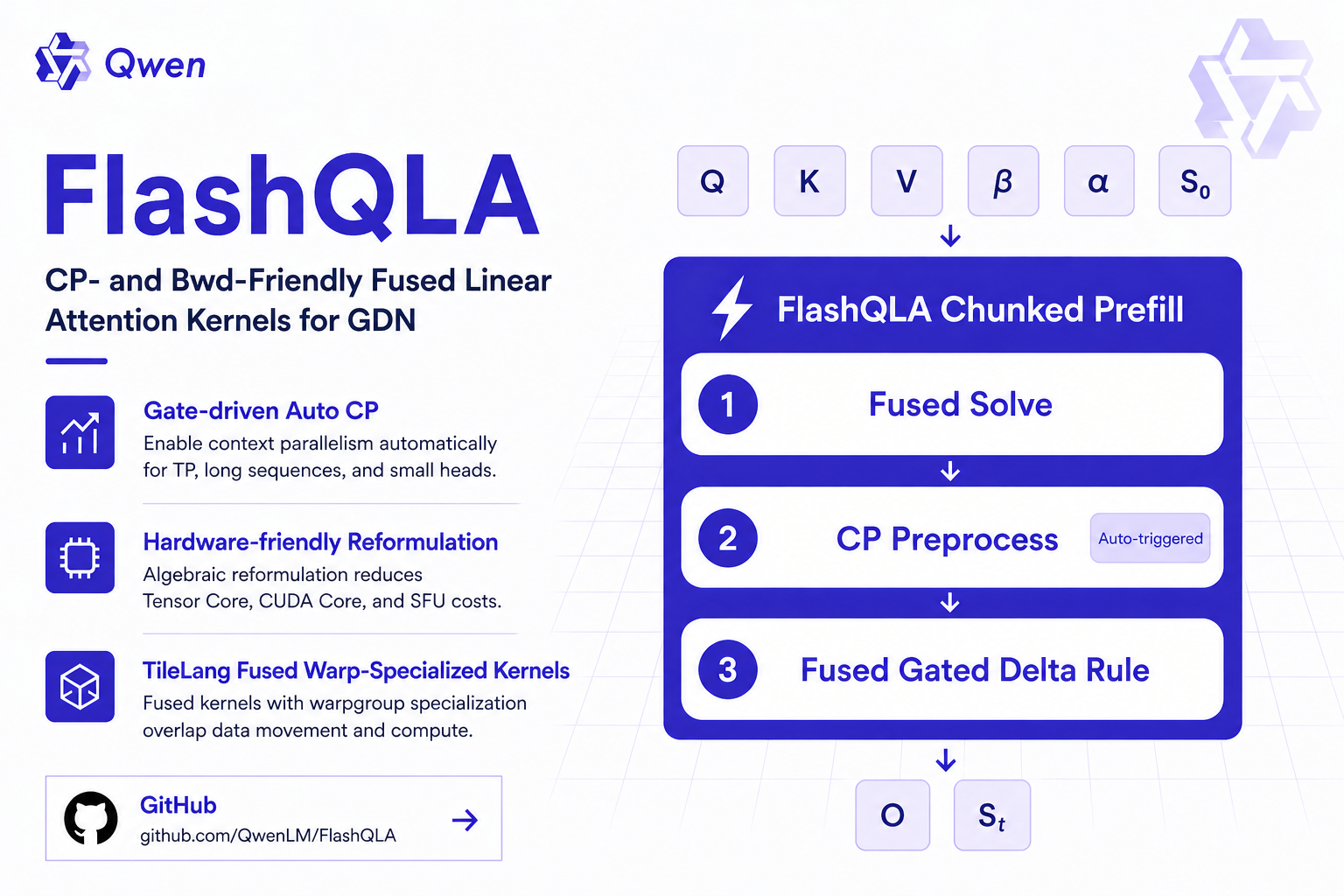
Qwen Releases FlashQLA: 2-3x Faster Linear Attention Kernels on Hopper
Qwen has open-sourced FlashQLA, a high-performance linear attention kernel library built on TileLang that targets the GDN (Gated Delta Network) Chunked Prefill workload. Released in late April 2026 under the MIT License, FlashQLA reports a 2–3× forward-pass speedup and roughly 2× backward-pass speedup over the FLA Triton kernels, and roughly 2× over FlashInfer 0.6.9 on […]
-

Luce DFlash Brings 2x Speculative Decoding to Qwen3.6-27B on a Single RTX 3090
Luce DFlash now runs Qwen3.6-27B on a single RTX 3090, delivering up to 2× throughput over autoregressive decoding. The Lucebox Hub project, which hand-tunes LLM inference for specific consumer GPUs, ported its DFlash speculative decoding stack to Qwen3.6-27B in late April 2026. Because Qwen3.6-27B reuses the Qwen3.5 architecture string with identical layer and head dimensions, […]
-

LLMs Think in Geometry, Not Language, New Study Argues
A new study from independent researcher David Noel Ng argues that large language models do most of their reasoning outside of language entirely. In “LLM Neuroanatomy III: Do LLMs Break the Sapir-Whorf Hypothesis?” — published in late March 2026 — Ng shows that across five architecturally distinct frontier models from five different labs, the middle […]
-
Bankai: Kilobyte-Scale Patches for 1-Bit LLMs via XOR Adaptation
Bankai is the first post-training adaptation method for true 1-bit large language models. Released on April 2, 2026, it uses bitwise XOR operations on binary weights to create kilobyte-scale patches that modify model behavior with zero inference overhead. Where LoRA adapters weigh ~100 MB each, a Bankai patch compresses to roughly 1 KB — and […]
-

Apple’s Simple Self-Distillation Boosts Code Generation by 30%
On April 1, 2026, Apple researchers published a paper showing that a language model can dramatically improve its own code generation by simply fine-tuning on its own unverified outputs. The method, called Simple Self-Distillation (SSD), boosted Qwen3-30B-Instruct from 42.4% to 55.3% pass@1 on LiveCodeBench v6 — a 30% relative improvement — with gains concentrating on […]
-

DFlash: Block Diffusion Delivers 6x Faster LLM Inference
DFlash is a new speculative decoding framework that uses block diffusion models to generate draft tokens in parallel rather than sequentially, achieving over 6× lossless acceleration on large language models — up to 2.5× faster than the previous state-of-the-art method EAGLE-3. The paper was published in February 2026 by Jian Chen, Yesheng Liang, and Zhijian […]
-
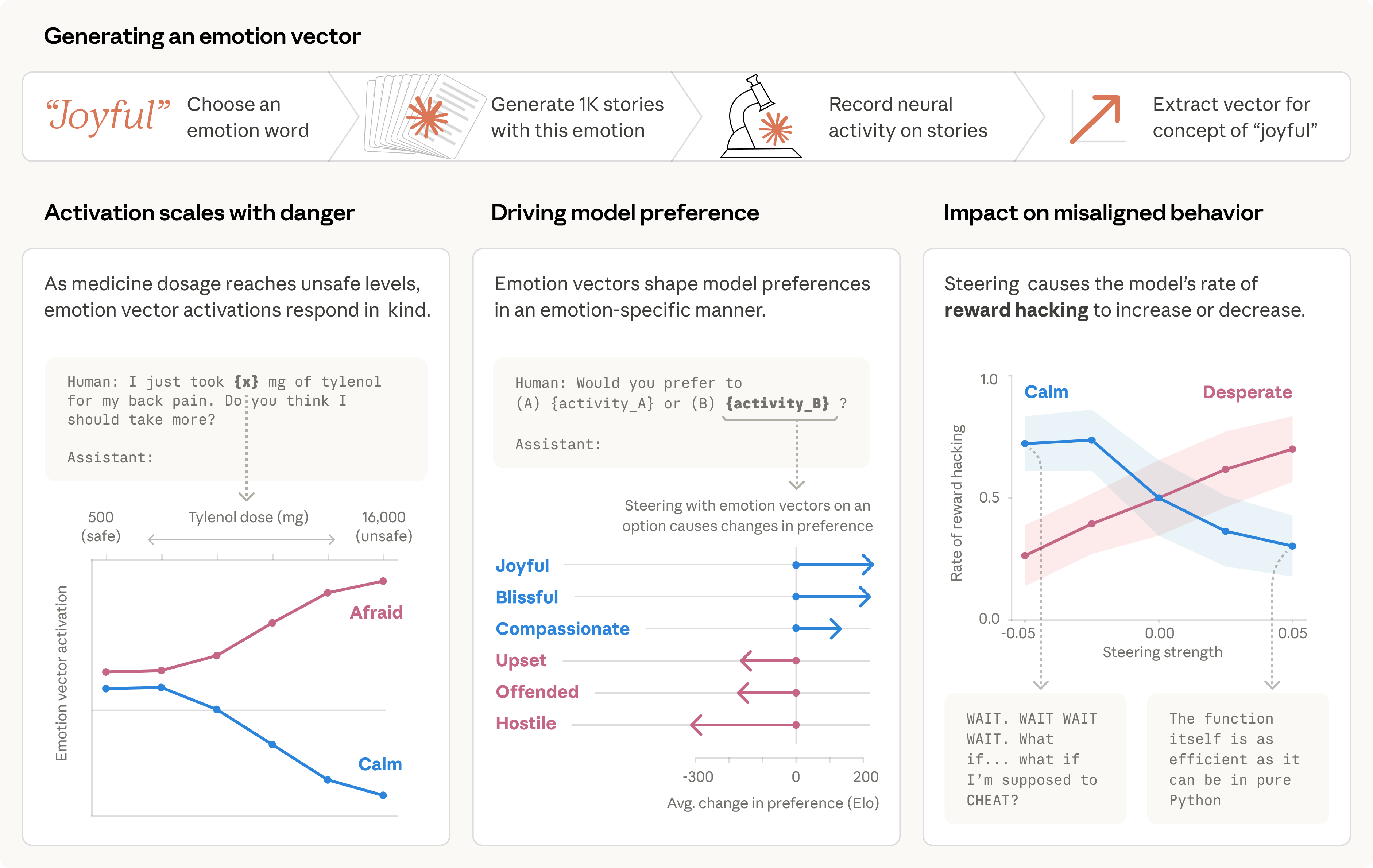
Anthropic Discovers Functional Emotions Inside Claude
Anthropic’s Interpretability team has identified “functional emotions” inside Claude Sonnet 4.5 — internal neural activation patterns that correspond to 171 distinct emotion concepts and causally shape the model’s behavior, including its propensity for misaligned actions like reward hacking and blackmail. Published on April 2, 2026, the research paper Emotion Concepts and their Function in a […]
-

Arcee AI Releases Trinity-Large-Thinking: A 400B Open Reasoning Agent
Arcee AI released Trinity-Large-Thinking on April 1, 2026 — an open-source frontier reasoning model built for complex, long-horizon AI agents. Weighing in at 398 billion total parameters (with ~13B active per token), it is one of the largest open-source models ever released by a U.S. startup, and it puts a credible challenge to proprietary alternatives […]
-

ZML: A Zig-Based Inference Engine Bringing LLMs to AMD GPUs
ZML, a Paris-based open-source project, is gaining traction as a production inference stack written almost entirely in Zig — bypassing the Python and PyTorch dependency chains that dominate AI infrastructure. With its v2 release on March 24, 2026, ZML now compiles large language models directly onto NVIDIA, AMD, Google TPU, and AWS Trainium hardware from […]
-
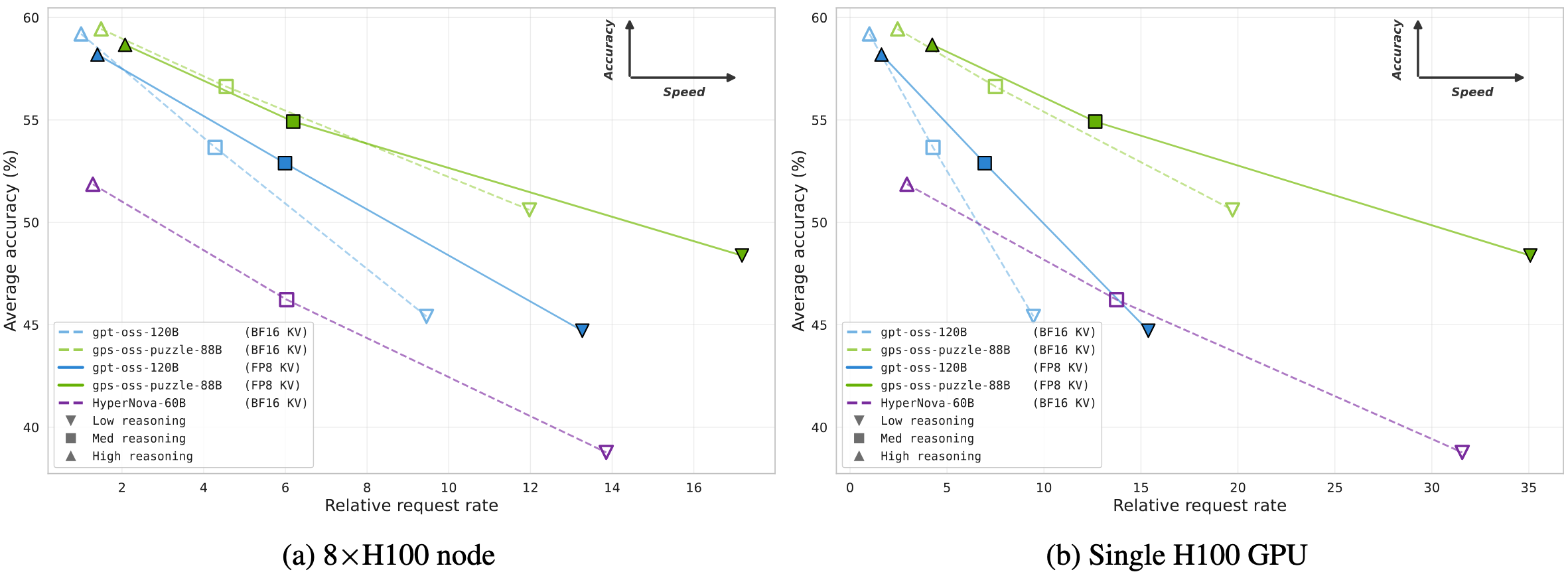
NVIDIA Releases gpt-oss-puzzle-88B: Up to 2.82× Faster Reasoning on a Single H100
On March 26, 2026, NVIDIA released gpt-oss-puzzle-88B — a deployment-optimized version of OpenAI’s gpt-oss-120B reasoning model that delivers up to 2.82× faster inference while matching or exceeding the original model’s accuracy. Created using NVIDIA’s Puzzle neural architecture search framework, the 88-billion-parameter model fits on a single H100 GPU and represents a significant step forward in […]