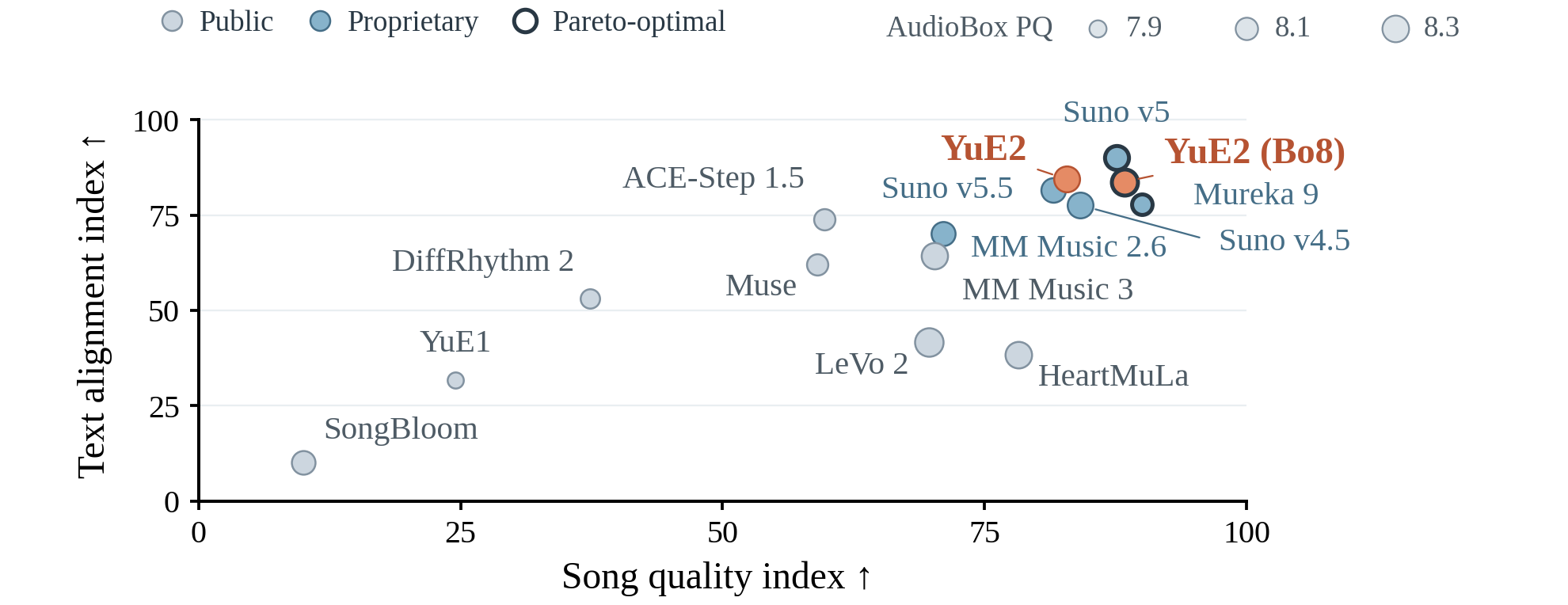
Multimodal Art Projection (M·A·P) published the weights for YuE2 on September 10, 2026 — a roughly 3.6-billion-parameter music generation model that turns a style prompt and lyrics into a complete 48 kHz stereo song, and, unusually, exposes the melody and chords it wrote as an editable score before rendering any audio. On WildSongBench, a 192-prompt evaluation the team released on September 5, YuE2’s best-of-8 configuration scores 6.9632 on the SongBench average against 6.8721 for Suno v5. It runs on a single 24 GB GPU.
Intermediate
Key points
- Multimodal Art Projection published the weights for YuE2 on September 10, 2026, a roughly 3.6-billion-parameter music generation model that turns a style prompt and lyrics into a 48 kHz stereo song.
- YuE2 first writes an editable score in ABC notation covering key, chords, and vocal and instrumental melodies, so a changed melody note re-renders with the audio following the edit.
- On WildSongBench, a 192-prompt evaluation the team released on September 5, YuE2’s best-of-8 configuration scores 6.9632 on the SongBench average against 6.8721 for Suno v5.
- The headline number is best-of-8, so single-pass YuE2 sits below Suno v5, and Suno v5 still leads on MuLan text alignment 0.5428 to YuE2’s 0.5068.
- First-party code, documentation, and the agent skill are Apache 2.0, but the model weights are CC BY-NC 4.0, which rules out commercial use.
The Score Is the Interface
Most text-to-music systems map a prompt straight to audio tokens. Whatever the model decided about key, tempo, or chord progression is buried in the waveform, and the only way to change it is to re-roll the generation and hope.
YuE2 inserts a symbolic step. The model first writes a score in ABC notation — beats, downbeats, key, chords, section structure, and separate vocal and instrumental melody voices on a shared event timeline. That score is human-readable text. You can open it, change the chord under the second chorus or move a melody note, and re-render. The audio follows the edit rather than being resampled around it.
This also gives the system its other two modes. A companion transcription model, SheetSage2, converts an existing recording into the same score format, which makes zero-shot cover generation a matter of keeping the melody and swapping the style prompt and lyrics — YuE2 reports a CLEWS mAP of 0.647 on SHS100K. And because the score is text, an agent can take plain-language feedback (“make the bridge minor”) and turn it into concrete score, style, and lyric revisions.
Architecture
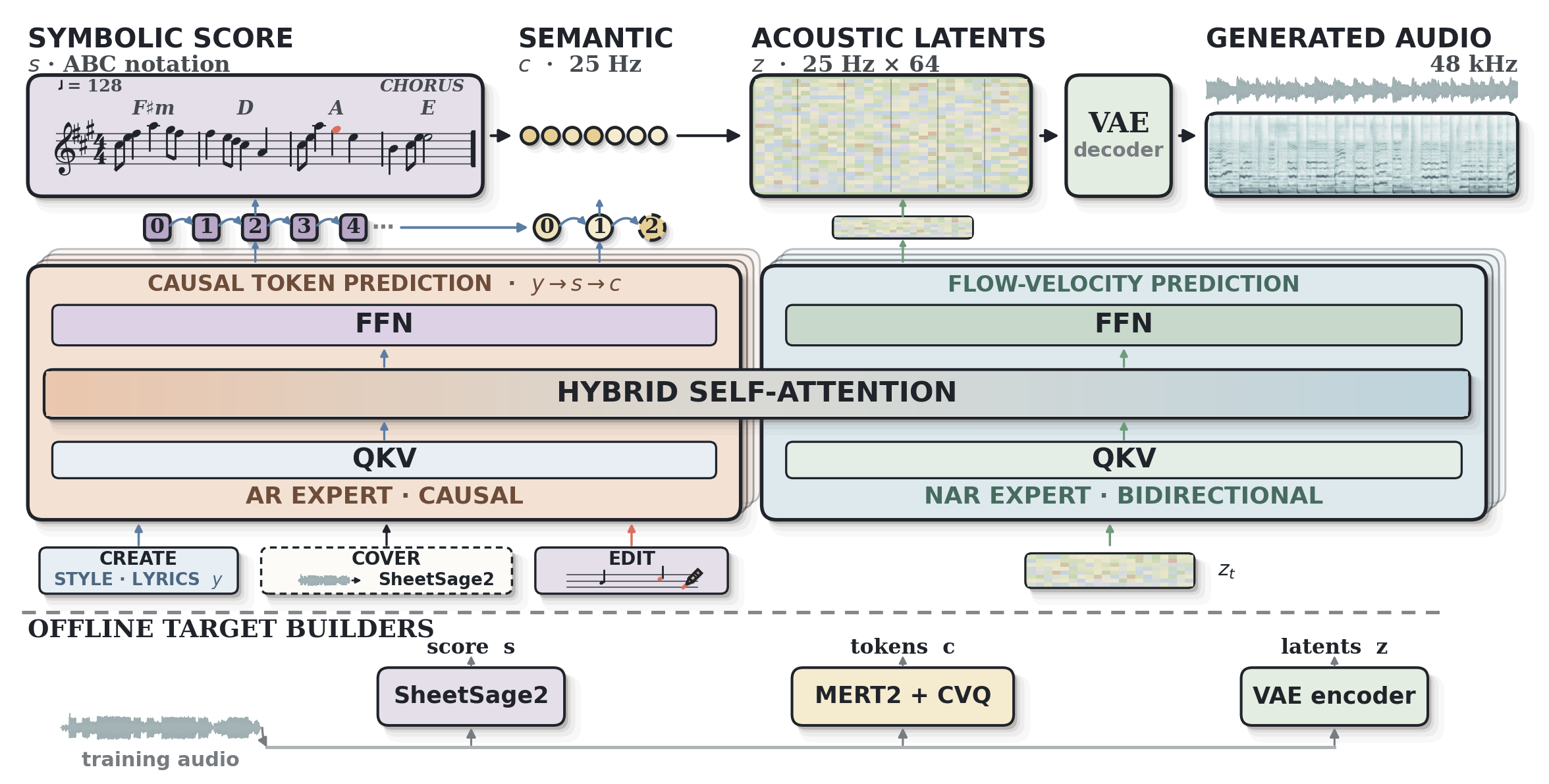
The 28-layer backbone is a Mixture-of-Transformers with two experts that share one attention computation but keep separate normalization, projections, and MLPs. An autoregressive expert runs causally and predicts the symbolic score and 25 Hz semantic tokens; a non-autoregressive expert runs bidirectionally and predicts flow velocities for the acoustic latents. A VAE decoder turns those latents into stereo audio at 48 kHz with no quantization step.
Two supporting models feed it. MERT2 (632M parameters, a ConvNeXt frontend over a 24-layer Conformer) supplies music representations and reports state-of-the-art results on 14 of 15 MARBLE metrics, including 91.72% genre accuracy on GTZAN. SheetSage2 tops 10 of 13 transcription benchmarks, including 82.51 vocal-melody F1 on RWC-Pop. Training volumes are disclosed per model: 700K hours for MERT2, 346K hours for YuE2 itself, and 28.4K hours for SheetSage2.
On an RTX 4090, the team reports a 3.6-minute song generated in 71 seconds at a peak of about 11.18 GiB of VRAM. The stated requirement is Linux, Python 3.12, and an NVIDIA GPU with BF16 support and 24 GB.
Benchmarks
WildSongBench scores 192 prompts across musicality, text alignment, and pronunciation error rate. Selected SongBench averages:
- YuE2 (best-of-8) — 6.9632, musicality 6.2666, PER 9.79%
- Mureka 9 (proprietary) — 6.9377
- Suno v5 (proprietary) — 6.8721, musicality 5.9918, PER 8.10%
- YuE2 (single pass) — 6.7316, musicality 5.9075, PER 8.44%
- MiniMax Music 3 — 6.2830
- ACE-Step 1.5 — 6.0118
- YuE 1 — 4.9165
Two caveats are worth reading off the table directly. The headline number is best-of-8, meaning eight generations were sampled and the best kept; single-pass YuE2 sits below Suno v5. And Suno v5 still leads on MuLan text alignment (0.5428 to YuE2’s 0.5068), so the win is concentrated in musicality and overall song quality rather than prompt adherence. The gap over YuE 1, released eighteen months earlier, is the more striking figure — nearly two full points.
What This Means
The benchmark parity is the headline, but the licensing and data disclosures may matter more for anyone deciding whether to build on this. First-party code, documentation, and the agent skill are Apache 2.0; the model weights are CC BY-NC 4.0, which rules out commercial use. That is a tighter constraint than MiniMax’s Music 3.0 community license, which permitted commercial deployment below a user threshold — the trade here is research freedom without a product path.
On training data, the project states that its models are trained on CC0 music and synthetic data, with Tokenwave.AI supplying most of the synthetic material under license. Music generation carries more direct copyright exposure than most modalities, and an explicit provenance claim — however hard to audit from outside — is a different posture from the silence that has been typical in this space. The project lists HKUST, M·A·P, Tokenwave.AI, NYU, Stanford, MBZUAI, NOIZ, and ACE STUDIO among its affiliations.
For teaching and research use, the editable score is the genuinely new affordance. A model that shows its harmonic and melodic decisions in notation before committing them to audio is a much better object to reason about in a classroom than one that emits a finished mix. The technical report is still forthcoming.
Related Coverage
- MiniMax Opens Music 3.0 Weights — No Territorial Carve-Out This Time — the ~11.1B model that YuE2 outscores 6.7316 to 6.2830 on WildSongBench
- ACE-Step 1.5: Open-Source Music Generation That Rivals Commercial AI — also benchmarked in the YuE2 table, at 6.0118
- Exploring SongBloom: Text-to-Music Generation with Hugging Face — the earlier open model at the low end of the same chart
- Foundation-1: A Producer-Focused AI Model for Structured Music Sample Generation — a different take on giving producers structural control
This post was drafted with AI assistance and reviewed by RITS staff.