On October 19, 2026, Ant Group’s inclusionAI lab released Ming-3.0-audio-flash, a 126-billion-parameter audio-language model that activates 6.5 billion parameters per token and answers either in text or in synthesized speech. The weights and inference code went up on Hugging Face, ModelScope and GitHub under the MIT licence, together with a compact 9.3-billion-parameter sibling, Ming-3.0-audio-tiny. It sits inside a five-model speech release covering synthesis and recognition too, and is one of the few open-weight models that transcribes audio and then speaks its answer.
Key points
- Ming-3.0-audio-flash has 126 billion total parameters and activates 6.5 billion per token; Ming-3.0-audio-tiny has 9.3 billion total and 2.7 billion active.
- Both checkpoints are MIT-licensed and handle Chinese and English speech, regional dialects, environmental sound and music.
- inclusionAI reports a 3.45 average Chinese ASR character error rate, 3.69 English word error rate and 9.40 dialect error rate in its own evaluation.
- The default 128K-context vLLM-Omni serving profile uses eight 80 GB H800 GPUs, while the SGLang profile serves text output on four.
- Speech output runs through an optional Talker module that supports built-in voices, reference-audio cloning and streaming delivery.
Intermediate
One Family, Two Sizes
Ming-3.0-audio-flash is a native audio-language model: audio arrives together with a text instruction and the model replies with an answer, a transcript, or a tool call. The 126B/6.5B split is a mixture-of-experts ratio, not distillation: the full checkpoint must be resident even though each token touches a small slice. Ming-3.0-audio-tiny keeps the same shape at 9.3B total parameters with 2.7B active, trading headroom for hardware that fits on a desk.
Both are listed as Chinese- and English-first, with the model card claiming robustness across accents, dialects, noisy rooms and multi-speaker recordings, plus non-speech sound, acoustic scenes and music — the part most speech models skip.
The release is younger than its repositories suggest: Hugging Face lists both as created on September 3, 2026, but the model cards, benchmark panels and the Ant Ling launch thread all date from October 19. Download counts, 22 for the flash checkpoint, still lag the announcement’s visibility.
Inside the Architecture
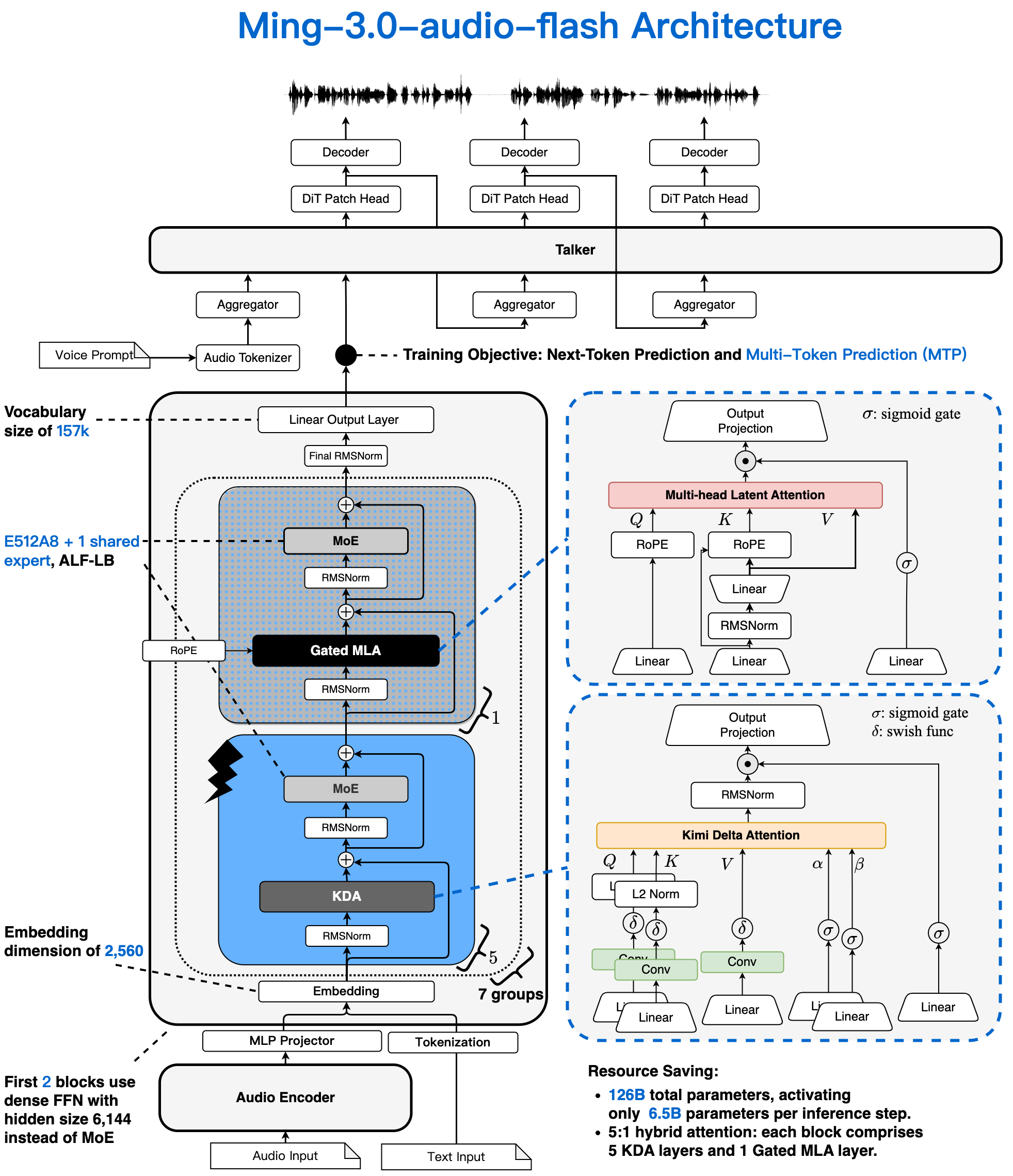
The audio front end is a 32-layer encoder at 1,280 dimensions with 20 attention heads and 128 mel bins, followed by three stride-2 downsampling stages and a linear projector into the language model’s 2,560-dimensional space. The configuration file allows a 3,000-frame audio context, and the backbone accepts 131,072 positions — the 128K window that dominates the deployment documentation.
The language backbone is 42 layers of sparse experts: 512 routed experts per layer, eight selected per token, plus one shared expert. The first two blocks are dense, the vocabulary is roughly 157,000 tokens, and attention alternates five Kimi Delta Attention layers to one gated multi-head latent attention layer — a linear-attention-heavy ratio built for long recordings. Training targets next-token and multi-token prediction jointly.
Speech output is a separate Talker stack, not a bolt-on vocoder: an audio tokenizer, aggregator and diffusion-transformer patch head feed a decoder that emits waveforms. Serving clients request modalities=["text", "audio"] and name a voice through Chat Completions’ audio.voice field; cloning takes a reference WAV plus its exact transcript, and a streaming client reports latency as audio arrives.
Benchmarks, and Where It Slips
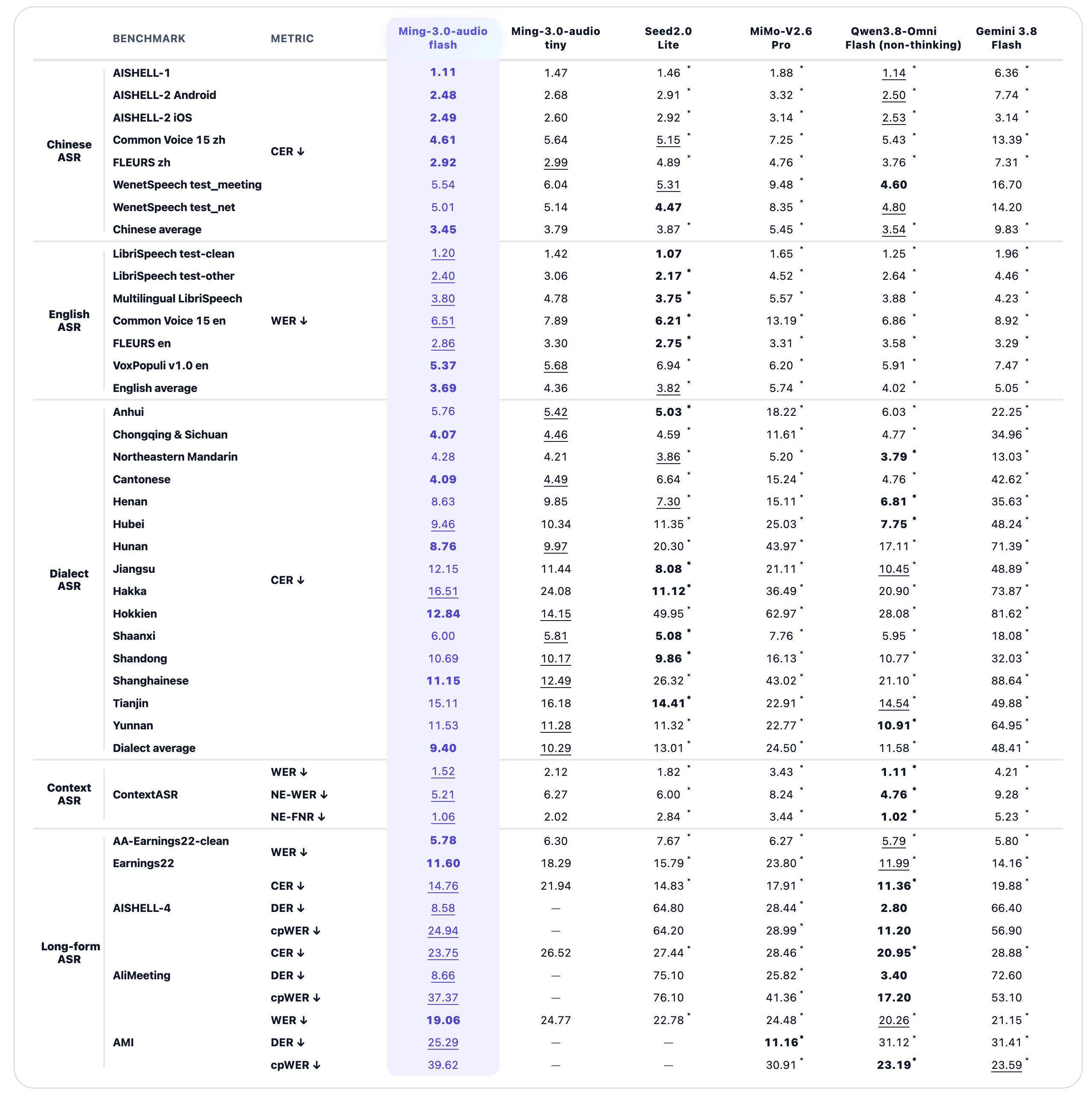
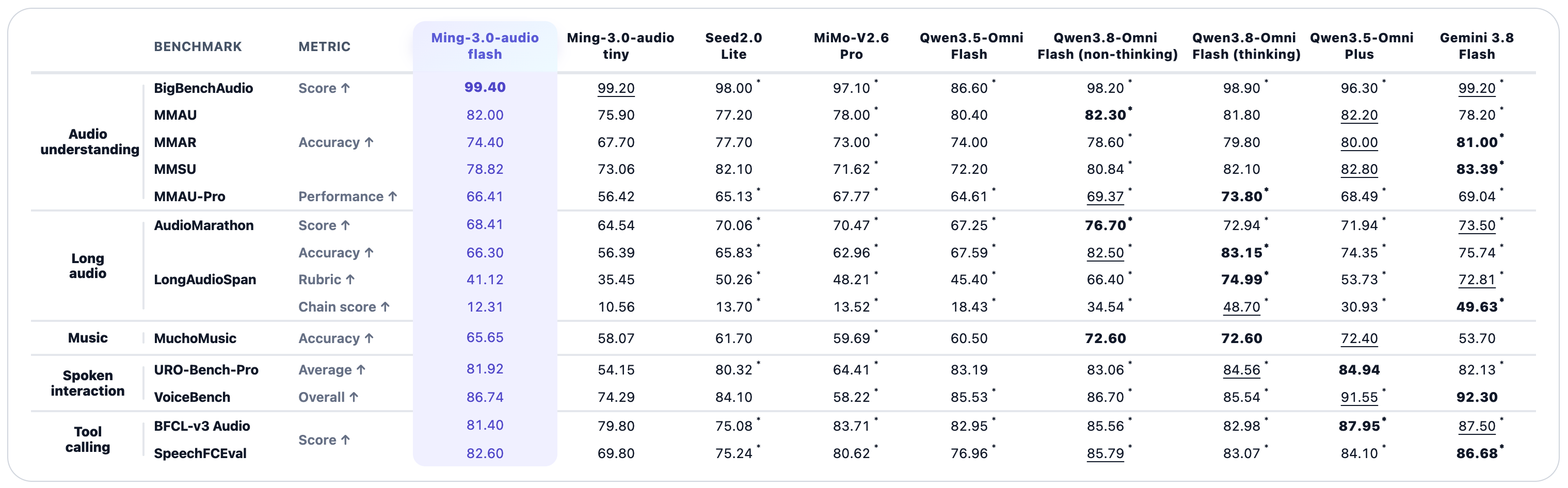
The headline recognition numbers are a 3.45 average character error rate on the Chinese set, 3.69 word error rate on English, and 9.40 across fourteen Chinese dialects — the row where the gap to Qwen3.8-Omni Flash (11.58) and Gemini 3.8 Flash (48.41) is widest. On audio intelligence the flash model scores 99.40 on BigBenchAudio, 82.00 on MMAU and 78.82 on MMSU, and leads spoken interaction with 81.92 on URO-Bench-Pro.
The same tables show the limits. Diarization on the AMI meeting corpus is 25.29, well behind MiMo-V2.6 Pro at 11.16, and the long-audio chain score is 12.31 against 34.54 for Qwen3.8-Omni Flash. On text the model is respectable rather than leading: MMLU-Pro 80.00 and GPQA Diamond 82.45, but IFBench 59.00 against 81.50. inclusionAI marks self-run comparisons with an asterisk and warns that rival scores were reproduced under its own prompts and decoding settings.
Hardware is the practical barrier. The reference 128K profile spreads the flash model across eight 80 GB H800 GPUs because vLLM reserves KV cache from the configured context at startup, and the full-audio variant parks the Talker on GPU 7; the SGLang path is validated on four GPUs and returns text only. The tiny model runs its Thinker on one GPU for text and ASR, needs two for speech out, and already has community 4-bit and 8-bit MLX conversions for Apple Silicon. There are no GGUF builds yet.
What This Means
Open-weight speech has mostly meant one capability at a time: a transcriber, a synthesiser, an audio classifier. Ming-3.0-audio puts recognition, sound understanding, reasoning and speech generation behind one MIT-licensed checkpoint, which changes what a small lab can assemble without a vendor contract — a meeting recorder that answers questions about the recording and reads the answer aloud, or a call-centre triage loop that never leaves the building. The price is memory: a 126B bfloat16 checkpoint needs a multi-GPU node even though 6.5B parameters do the work per token, so the tiny variant is what most researchers will actually run.
Cloning is worth describing plainly: it needs a reference clip and its transcript, and nothing in the release describes a consent or watermarking mechanism, so provenance stays the deployer’s problem — the part to write down before the demo, not after.
Related Coverage
- Ant Group Open-Sources Ming-Image-0.1-Design for Text-Heavy Graphics — the same inclusionAI lab’s September 2026 MIT-licensed image release, from the Ming family’s other modality.
- Fish Audio Releases Drama 3, a 35B Open-Weight Directable TTS Model — a speech-output release from four days earlier, built around natural-language acting directions.
- Voxtral Transcribe 2: Mistral’s Open Real-Time Speech-to-Text — an open-weight recognition model, the transcription half of what Ming-3.0-audio combines.
This post was drafted with AI assistance and reviewed by RITS staff.
Sources
- Hugging Face — inclusionAI/Ming-3.0-audio-flash model card
- Hugging Face — inclusionAI/Ming-3.0-audio-tiny model card
- GitHub — inclusionAI/Ming-3.0-audio-flash repository and serving documentation
- Ant Ling (@AntLingAGI) — launch thread for the five Ming-3.0 speech models, October 19, 2026
- Art Realm AI — “Ming-3.0: Ant Group Open-Sources MIT Voice Design TTS and ASR,” October 19, 2026
- Hugging Face — mlx-community/Ming-3.0-audio-tiny-4bit community conversion