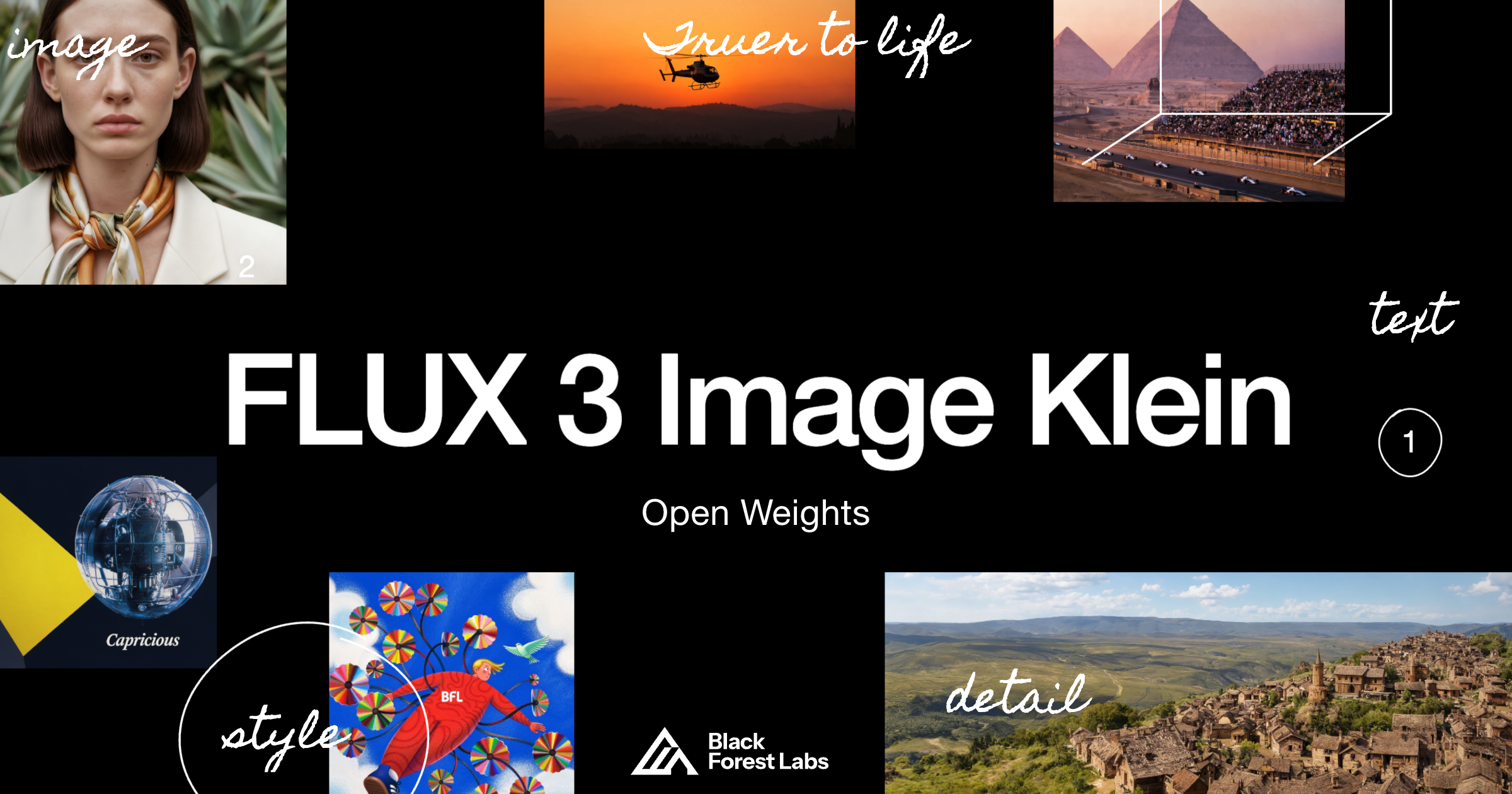
Lead — On October 15, 2026, Black Forest Labs released FLUX 3 Image Klein, a 5.6-billion-parameter open-weights model that handles text-to-image generation, image editing, and multi-reference generation with up to 10 reference images in a single set of weights. It is the German lab’s second open-weights release from the FLUX 3 family, following September’s FLUX 3 Action for robotics, and it carries over the larger FLUX 3 Image model’s native 4K generation, pixel-level editing, and prompt-level bounding boxes. Weights are on Hugging Face under the FLUX Kommunity License, and the distilled checkpoint is also served through the BFL API from $0.009 per 1K image.
Intermediate
Key points
- Black Forest Labs released FLUX 3 Image Klein on October 15, 2026, a 5.6-billion-parameter open-weights model for text-to-image generation, image editing and multi-reference generation with up to 10 reference images.
- Two checkpoints ship: undistilled Klein Base expects 50 sampling steps at guidance 3.5 for fine-tuning, while Klein is step-distilled to 16 steps with no guidance and backs the BFL API.
- BF16 weights ship with FP8 and NVFP4 variants and an INT8 build developed with NVIDIA, all using Qwen3-VL-4B-Instruct as a separate Apache-2.0 text encoder, so 5.6B covers the image transformer only.
- Weights are on Hugging Face under the FLUX Kommunity License, which permits non-commercial use and commercial output by Qualifying Users under US$5M revenue, but not blanket commercial fine-tuning or distribution.
- The article notes every quality number is BFL’s own internal evaluation, claiming first place in text-to-image, multi-reference generation and image editing plus a 91 Elo gain over FLUX.2 [klein] 9B.
What Ships in the Release
Two checkpoints go out together. Klein Base is undistilled, expects 50 sampling steps at a guidance scale of 3.5, and is aimed at fine-tuning, LoRA training and research. Klein is step-distilled to 16 steps with no guidance, and is the checkpoint behind the BFL API. Alongside the BF16 weights, BFL published FP8 and NVFP4 variants and an INT8 build developed with NVIDIA. All of them use Qwen3-VL-4B-Instruct as the text encoder — a separate Apache-2.0 component, so the “5.6B parameters” figure refers to the image transformer only, not the whole pipeline.
The headline capability is layout control. A prompt can carry a JSON list of elements, each with a bounding box on a 0–1000 grid and an id referenced in the caption; edits can add a source and target box per element, with a null target removing it. BFL describes boxes as guidance for placement and scale rather than hard masks — an element can spill past its box. The reference CLI also runs a prompt upsampler by default, a separate 18.8 GB model that rewrites a short request into the full scene caption the model expects; BFL notes that short prompts produce generic output.
Benchmarks and the Speed–Quality Frontier
Every quality number here is BFL’s own internal evaluation, and the claim is specific: first place in text-to-image, multi-reference generation and image editing, ahead of larger open-weights models and above the closed Ideogram V4.5 and FLUX.2 [pro]. At 5.6B it is the smallest open model in the chart, against 7B for Qwen-Image 2.1 and 12.9B for Krea 2. Against BFL’s own FLUX.2 [klein] 9B, the company reports a gain of 91 Elo in text-to-image and 70 in image editing while using 38% fewer parameters. Krea 2 does not support image editing and is left out of that comparison.
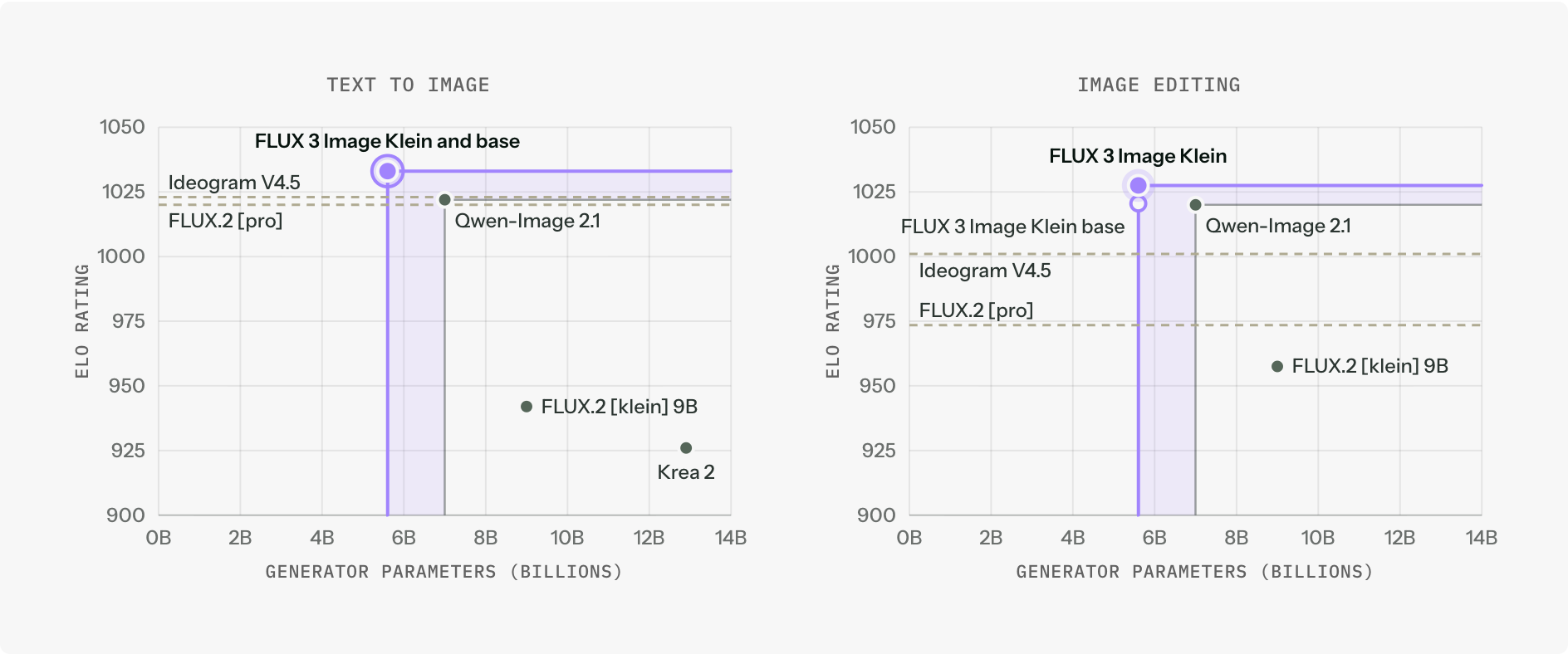
Latency is measured end to end, including queueing, and BFL reports a median of 4.54 seconds for text-to-image and 7.18 seconds for editing. The methodology is worth reading closely: FLUX 3 Image Klein was timed on BFL’s own servers, while the comparison models were timed from the client, folding in polling and network time. Krea 2 was run on its Medium tier; its Large tier took 31.1 seconds.
Running It Locally
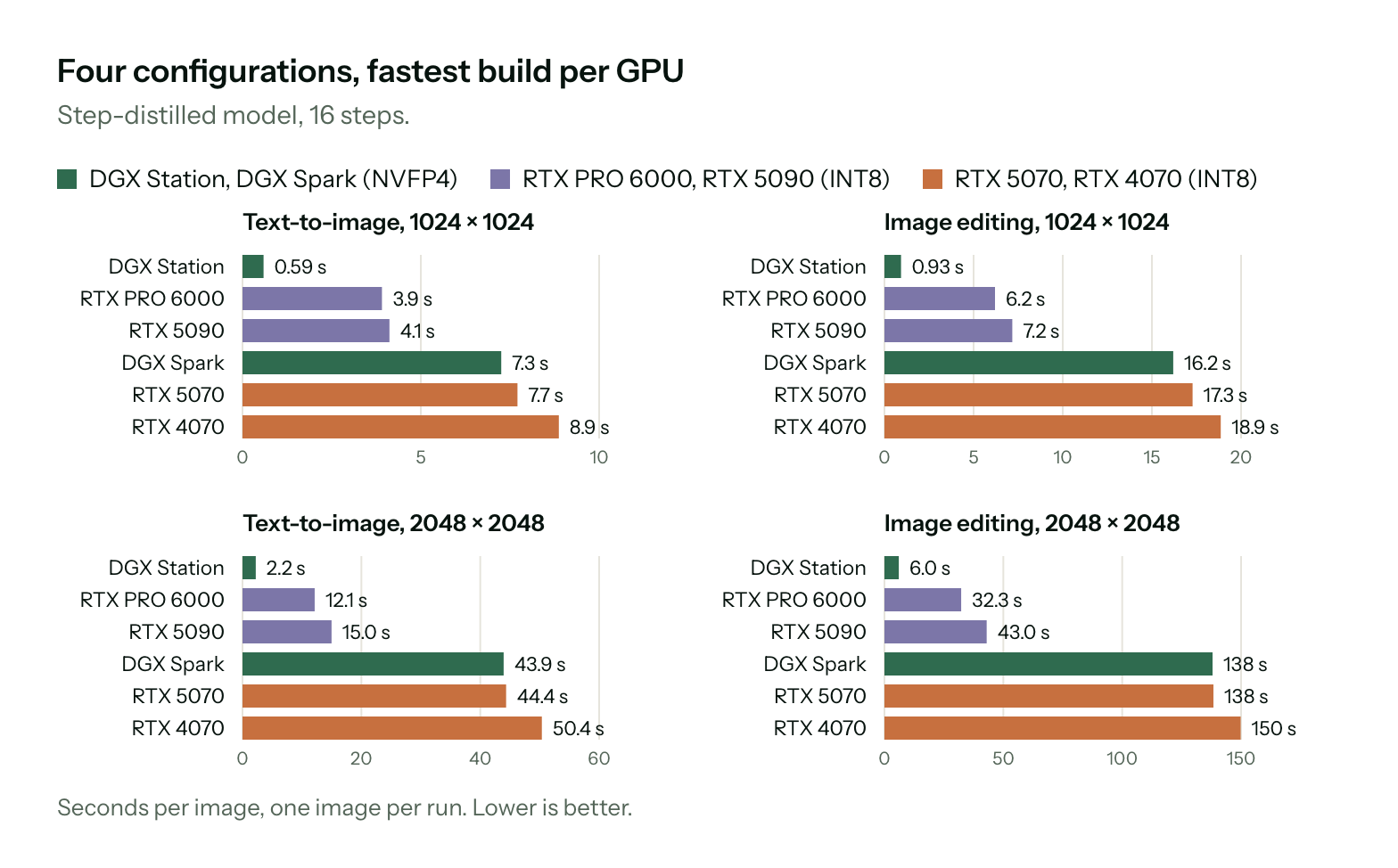
Klein’s pitch is that a frontier-class image model now fits on a laptop. The generator weights need 11.2 GB in BF16 or 5.6 GB in FP8, and with the INT8 build BFL says it runs on NVIDIA GeForce RTX GPUs with as little as 8 GB of VRAM through ComfyUI or Diffusers. With the distilled model and INT8, a 1MP image takes about 4 seconds on an RTX 5090 and under 9 seconds on an RTX 4070. On an NVIDIA GB300 in NVFP4, BFL puts it under 0.6 seconds.
Peak memory is a different number from file size. BFL’s reference code on a B200 at 1024×1024 with the prompt upsampler disabled peaks at 31 GB in BF16, 26 GB in FP8 and 25 GB in NVFP4; leaving the upsampler on adds roughly 28 GB on an 80 GB GPU. The charts below, measured by NVIDIA, cover the fastest build for each GPU with RTX results recorded in ComfyUI.
License, Safety, and Known Limits
FLUX 3 Image Klein ships under the FLUX Kommunity License v1.0. It permits non-commercial use plus commercial output generation by “Qualifying Users” with less than US$5M in gross annualized revenue including affiliates. BFL is explicit that this is not blanket permission for commercial fine-tuning or distribution — larger organisations go through self-hosted licensing or the API. The license also lists out-of-scope uses including military purposes, surveillance and biometric processing.
“By sharing our research openly, we created a global community of developers and creators who are helping to advance the field together,” said Robin Rombach, co-founder and CEO of BFL. “FLUX 3 allows that community to adapt the same foundation to very different needs, from creative generation to robotics.”
On safety, BFL says it applies dataset filters during pre-training and targeted fine-tuning after it, and that both checkpoints were red-teamed internally and evaluated by external safety partner Cinder before release. The model card is equally direct about limitations: the model “is not intended or able to provide factual information,” and rendered text may be inaccurate or distorted.

What This Means
The interesting move here is not the Elo chart but the direction of travel. BFL spent 2024 and 2025 shipping image models of 12B parameters and up; Klein is 5.6B and deliberately aimed at 8 GB of VRAM. That is the same bet Alibaba made with the 6B Z-Image family, and a sign that open image models are converging on the size class consumer hardware can actually run.
It also puts pressure on the closed comparison set: a 5.6B open model claiming parity with Ideogram V4.5 and FLUX.2 [pro] on BFL’s own evals is a claim independent leaderboards have not yet tested, and the timings are not apples-to-apples. Treat the latency chart as a frontier sketch, not a refereed result.
The licensing deserves as much attention as the benchmarks. An open-weights release whose commercial exception stops at US$5M in revenue is free for most academic labs and startups, and a deliberate upsell for everyone else — a narrower grant than an Apache-2.0 or MIT release, and worth reading before any production build.
Related Coverage
- Black Forest Labs Releases FLUX 3 Action, an Open-Weight Robot Model — the first open-weights release from the FLUX 3 family, one month earlier.
- Black Forest Labs Unveils FLUX 3, a Multimodal Image, Video, Audio and Action Model — the shared architecture Klein’s image transformer is drawn from.
- Z-Image: Alibaba’s Efficient 6B Open-Source Image Generation Model — the other major open image model in Klein’s parameter class.
- FLUX.1 Kontext [dev] Released: Open-Weights Model for Advanced Image Editing — where BFL’s open-weights editing line started in 2025.
This post was drafted with AI assistance and reviewed by RITS staff.
Sources
- Black Forest Labs — FLUX 3 Image Klein
- Hugging Face — FLUX 3 Image Klein model card (distilled)
- Hugging Face — FLUX 3 Image Klein Base model card
- GitHub — FLUX 3 Image Klein reference inference code
- BFL Documentation — FLUX 3 Image bounding boxes
- GlobeNewswire (via The Manila Times) — Black Forest Labs Expands Access to Frontier Visual Intelligence With Open Weights Release of FLUX 3 Image Klein
- Unite.AI — New 5.6B-Parameter FLUX 3 Image Klein Debuts as Open-Weights Release