RoyalCities has released Foundation-1, a specialized text-to-sample AI model built on Stability AI’s Stable Audio Open architecture. Unlike general-purpose music generators that output full songs, Foundation-1 is designed for actual music production workflows — generating tempo-synced, key-aware, bar-structured audio loops with fine-grained control over instrumentation, timbre, effects, and musical phrasing.
Intermediate
Key points
- RoyalCities released Foundation-1, a specialized text-to-sample AI model built on Stability AI’s Stable Audio Open architecture.
- Unlike general-purpose music generators that output full songs, Foundation-1 produces structured audio samples such as loops, phrases and textures for a producer’s existing workflow.
- The model supports 10 instrument families, BPM-aware generation at 100, 110, 120, 128, 130, 140 and 150 BPM, and bar-aware loops of 4 or 8 bars that loop within supported tempos.
- It is a fine-tune of stabilityai/stable-audio-open-1.0 and ships as a 16-bit safetensors checkpoint, needing approximately 7 GB VRAM during generation with a minimum of 8 GB recommended.
- Foundation-1 is licensed under the Stability AI Community License, free for non-commercial use and available for limited commercial use by entities with annual revenues under $1 million.
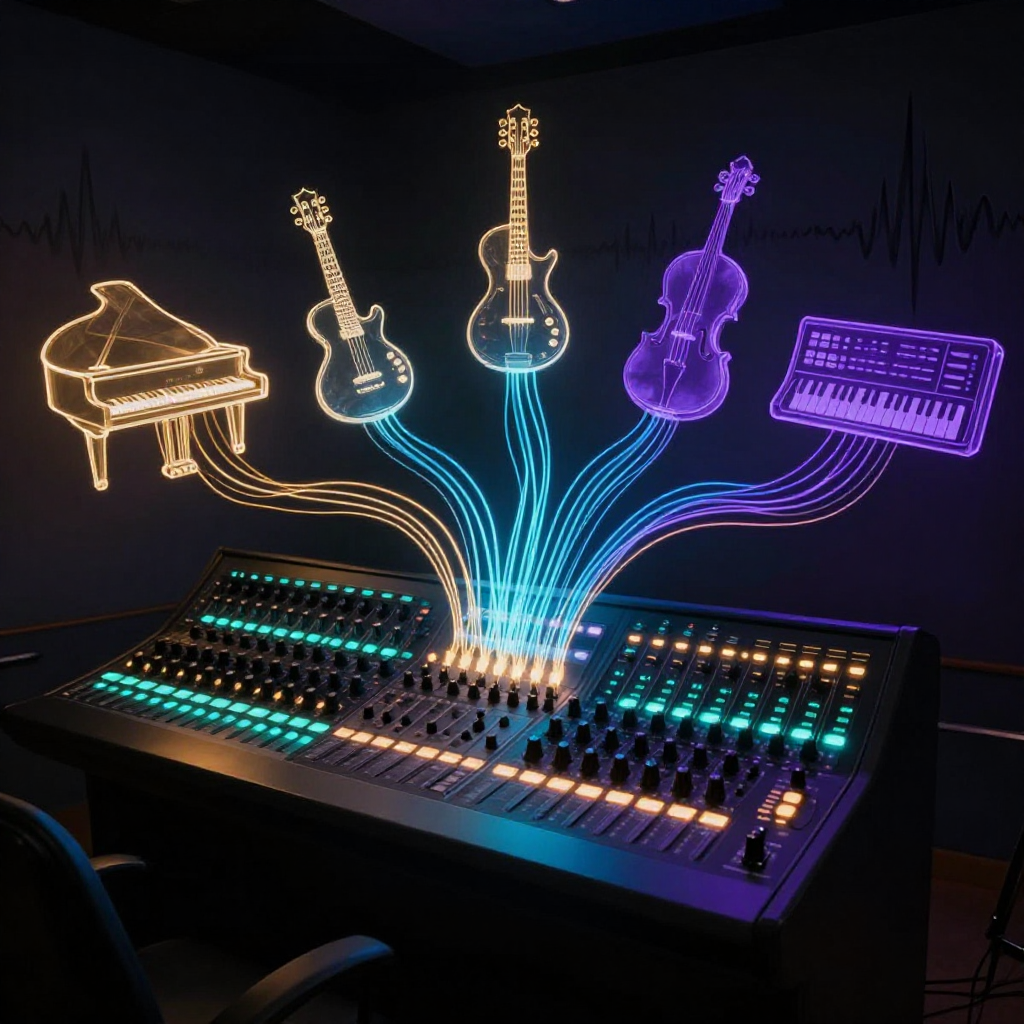
What Makes Foundation-1 Different
Most AI music tools generate complete tracks from text prompts. Foundation-1 takes a different approach: it produces structured audio samples — loops, phrases, and textures — that slot directly into a producer’s existing workflow. The model understands musical structure at a granular level, separating instrument identity from timbral character and treating effects as composable layers.
The model supports:
- 10 instrument families — Synth, Keys, Bass, Bowed Strings, Mallet, Wind, Guitar, Brass, Vocal, and Plucked Strings — each with multiple sub-families (FM Synth, Wavetable Bass, Grand Piano, Hammond Organ, etc.)
- BPM-aware generation at 100, 110, 120, 128, 130, 140, and 150 BPM
- Bar-aware loops (4 bars or 8 bars) that loop perfectly within supported tempos
- Key and mode support across major and minor keys with enharmonic equivalents
- Timbral descriptors like Warm, Gritty, Analog, Airy, Wide, and Digital — letting producers shape sonic character independently of instrument choice
- FX prompting for reverb, delay, distortion, phaser, and bitcrush at multiple intensity levels
Technical Details
Foundation-1 is a fine-tune of stabilityai/stable-audio-open-1.0, trained on a hand-crafted, labeled audio dataset with instrument hierarchy-based conditioning and explicit timbre and FX representation. The model ships as a 16-bit safetensors checkpoint (Foundation_1.safetensors) with no quality loss compared to 32-bit.
Hardware requirements are modest: approximately 7 GB VRAM during generation, with a minimum of 8 GB recommended. On an RTX 3090, generation takes roughly 7–8 seconds per sample. The recommended interface is the RC Stable Audio Tools fork, which adds dynamic model loading, one-click random prompt generation, BPM/bar auto-fill, key signature controls, automatic audio-to-MIDI conversion, and auto-trimming.
A typical prompt follows a structured format:
Bass, FM Bass, Medium Delay, Medium Reverb, Low Distortion,
Phaser, Sub Bass, Acid, Gritty, Wide, Thick, Warm, Clean,
Pitch Bend, 303, 8 Bars, 140 BPM, E minor
The model also supports notation-driven terms — chord progressions, melodies, arpeggios, triplets, rising/falling phrases — giving producers control over musical behavior, not just sound design.
Why It Matters
The AI music generation space has seen rapid growth, from ACE-Step 1.5 to ElevenLabs’ Eleven Music, but most tools target end-to-end song generation. Foundation-1 carves out a niche by targeting the sample and loop layer of production — the building blocks that producers actually work with in DAWs like Ableton, Logic, or FL Studio.
This producer-first philosophy means Foundation-1 isn’t competing with full-song generators. Instead, it augments human creativity by generating the raw material that musicians then arrange, layer, and transform. The model’s composable control system — where instrument, timbre, FX, and notation are separate prompt dimensions — gives users a level of precision that full-song models typically lack.
Foundation-1 is licensed under the Stability AI Community License, making it free for non-commercial use and available for limited commercial use by entities with annual revenues under $1 million. It runs locally on consumer GPUs, requiring no cloud API or subscription.
Related Coverage
- ACE-Step 1.5: Open-Source Music Generation That Rivals Commercial AI — full-song generation on consumer hardware
- ElevenLabs Unveils Eleven Music — studio-quality tracks from text prompts
- Exploring SongBloom: Text-to-Music Generation with Hugging Face — BLOOM-based music synthesis
- Stable Radio — earlier project combining Stable Audio with image generation
This post was drafted with AI assistance and reviewed by RITS staff.
Leave a Reply