Lead — On October 6, 2026, Google DeepMind released EmbeddingGemma 2, a 740-million-parameter open model that maps text, code, images, video, and audio into a single shared 768-dimensional vector space. Built on the Gemma 4 architecture and shipped under the commercially permissive Apache 2.0 license, it is designed to run on phones and laptops rather than data-center accelerators. It is the successor to EmbeddingGemma, the text-only embedder Google says has passed 20 million downloads.
Intermediate
Key points
- On October 6, 2026, Google DeepMind released EmbeddingGemma 2, a 740-million-parameter open model that maps text, code, images, video, and audio into a single shared 768-dimensional vector space.
- The model is built on the Gemma 4 architecture, shipped under the Apache 2.0 license, and designed to run on phones and laptops rather than data-center accelerators.
- The design is modular: a 270M-parameter text and code backbone can pair with an optional 170M vision encoder and an optional 300M audio encoder.
- The text and code path is an adapted Gemma 4 decoder with an 8,192-token context window, four times that of the first EmbeddingGemma.
- Google reports EmbeddingGemma 2 improves MTEB (Code) from 68.76 to 78.68 and measures about 191 MB of active RAM for the text-only weights on a Pixel 11 Pro.
One Vector Space for Every Modality
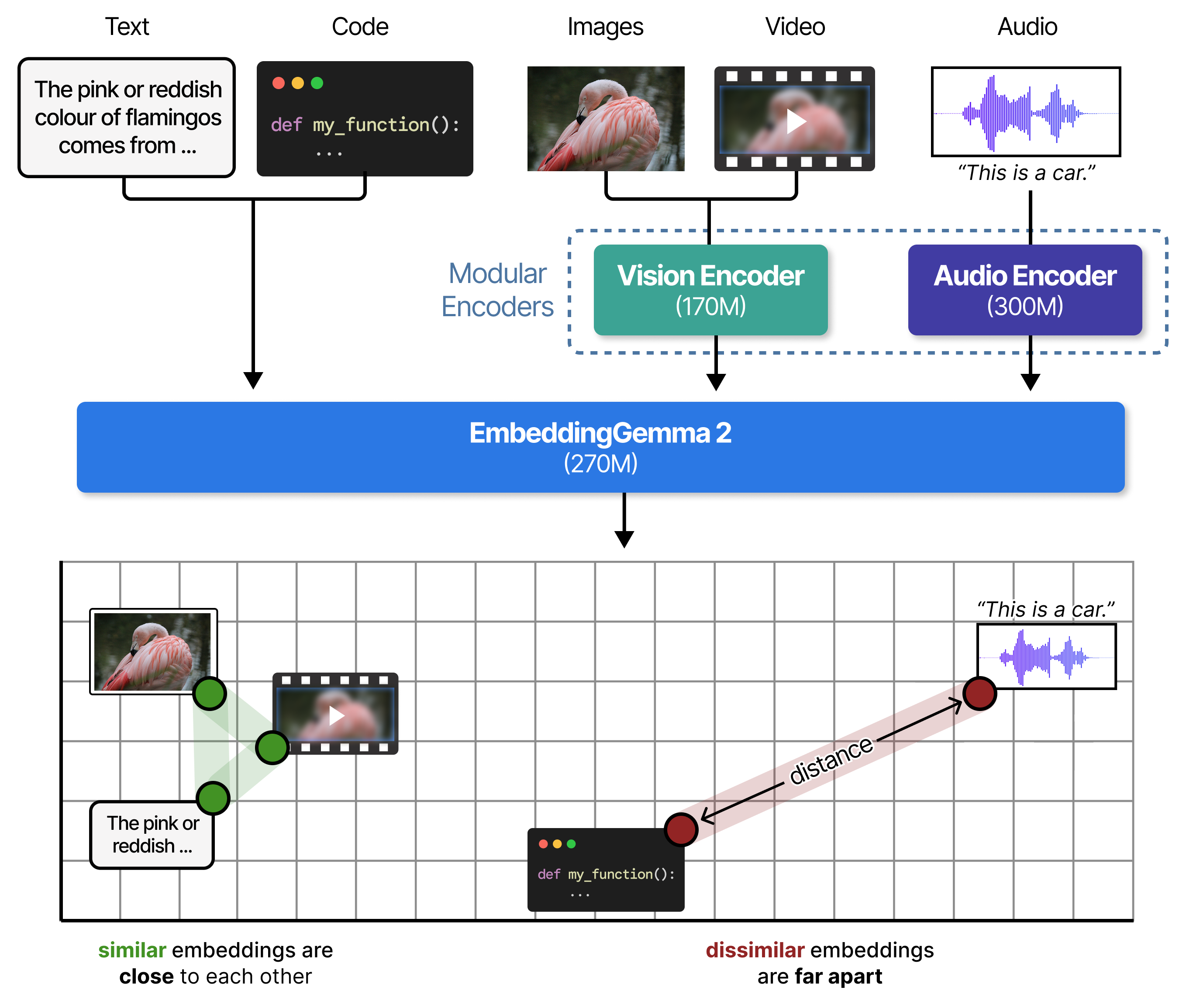
An embedding model turns content into a vector of numbers that captures meaning, so that similar items land close together and become easy to search or compare. In a retrieval-augmented generation (RAG) pipeline, these vectors let a language model pull in fresh information it was never trained on. EmbeddingGemma 2’s headline change is that the same model now embeds more than text: a written query can retrieve a photo, a voice memo can retrieve a video clip, and an interleaved product listing containing text, images, and a demo video collapses into a single embedding.
The design is modular rather than monolithic. A 270M-parameter text and code backbone (130M transformer plus a 140M embedder) can be paired with an optional 170M vision encoder and an optional 300M audio encoder. Developers load only what they need — 270M for text, 440M for text and vision, 570M for text and audio, or the full 740M for everything — and every configuration projects into the same compatible space. A query embedded with the text-only setup can therefore be matched directly against documents embedded by the full multimodal model, and adding a modality later does not require re-embedding an existing index.
How It Works
The text and code path is an adapted Gemma 4 decoder with an 8,192-token context window — four times that of the first EmbeddingGemma. Because every modality draws on the same token budget at a fixed rate, a single input can hold roughly 29 images (280 tokens each), 58 video frames (140 tokens each, sampled at one frame per second), or about 5.5 minutes of audio (25 tokens per second), or an interleaved mixture. Placing the tokens <|image|>, <|video|>, or <|audio|> inside a text string marks where each media item belongs.
Storage is handled through Matryoshka Representation Learning (MRL), which trains the model so that a 768-dimensional output can be truncated to 512, 256, or 128 dimensions and re-normalized, cutting vector-database footprint by up to 6×. At 256 dimensions, multilingual text and code quality is close to lossless and image, video, and speech retrieval retain roughly 95% of full quality. Google recommends reserving 128 dimensions for text-only workloads, where multimodal quality drops substantially.
Two practical notes from the model card: run inference in bfloat16 or float32, never float16, because the model’s activation range exceeds float16’s dynamic range and will otherwise return NaN or silently degraded embeddings; and always re-normalize after truncating, since slicing a unit-length vector does not preserve its length.
Benchmarks and On-Device Footprint
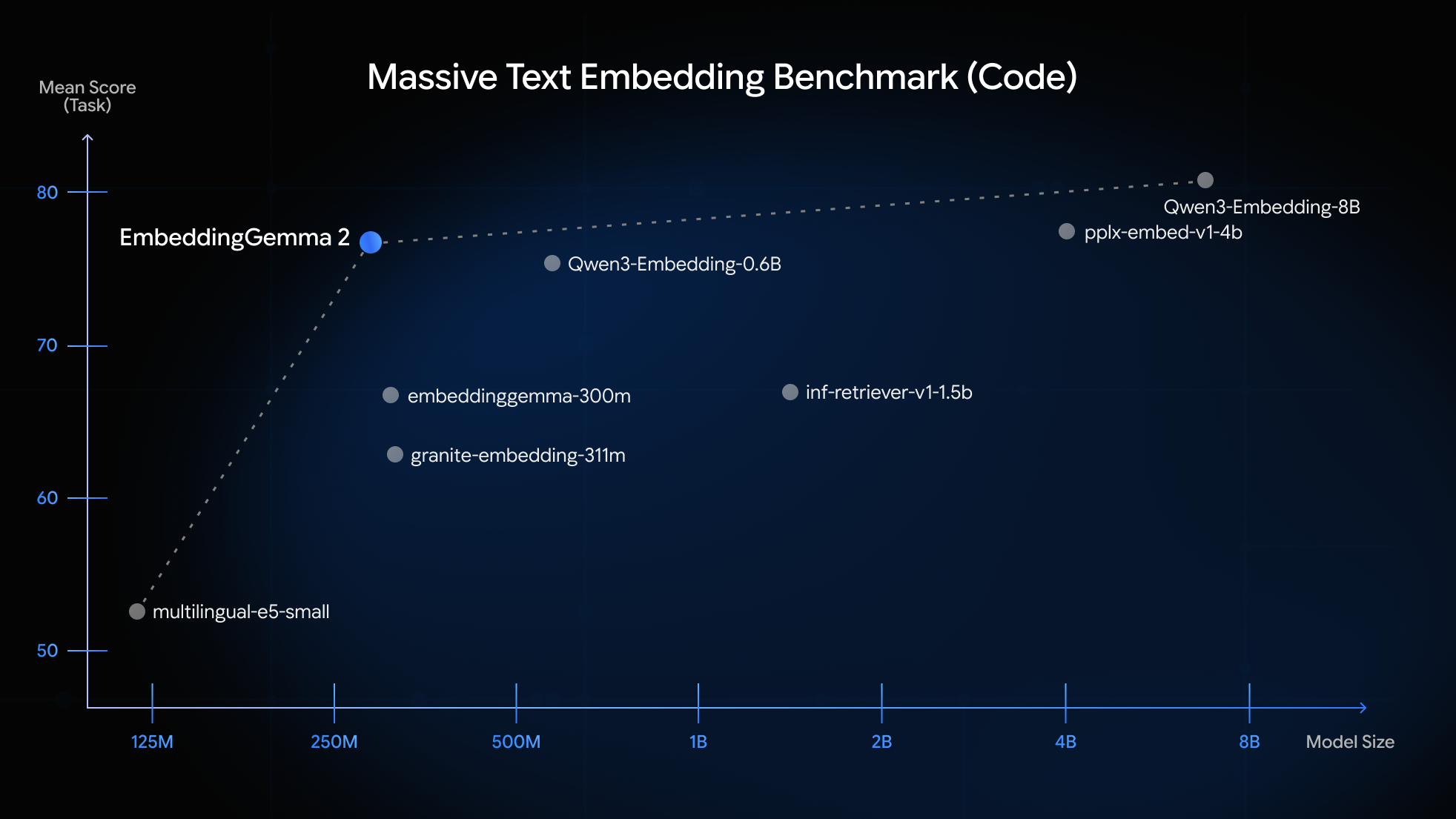
Google reports best-in-class scores among sub-1B multimodal embedders. On MTEB (Code), EmbeddingGemma 2 jumps from 68.76 to 78.68 — a 9.92-point gain, or roughly 14% — while multilingual text performance holds steady (MTEB multilingual v2: 61.36 vs. 61.15). On vision and audio it sets new marks for its size class: MIEB Lite 64.64, MMEB v2 overall 59.01, MSEB retrieval 69.54, and MAEB 49.39. Google notes that larger specialist models still lead some boards.
With quantization-aware training, Google measures about 191 MB of active RAM for the text-only weights and about 567 MB for the full multimodal model on a Pixel 11 Pro. On a MacBook M5 Pro GPU, the Google AI Edge team clocked 37.3 ms per image using a reduced 70-token vision budget. Weights are available on Hugging Face and Kaggle in Safetensors, GGUF, and LiteRT builds, with support in sentence-transformers, transformers, vLLM, SGLang, MLX, llama.cpp, Ollama, and LM Studio; fine-tuning guidance comes from Unsloth, and Qdrant covers vector storage.
What This Means
EmbeddingGemma 2 sits at an interesting intersection. Google’s cloud-native sibling, Gemini Embedding 2, offers comparable multimodality only through a paid API. EmbeddingGemma 2 puts a similar capability in Apache-2.0 weights that run offline, which makes it a natural fit for privacy-sensitive retrieval, on-device search, and codebase indexing. Its code-retrieval gain is the most immediately useful result for developers building local coding agents. The main caveat is that bigger open alternatives such as Alibaba’s Qwen3-VL-Embedding-2B still report higher scores on some vision benchmarks with roughly 2.7× the parameters — so the tradeoff is quality-per-parameter and footprint, not absolute performance.
Related Coverage
- Google Launches Gemini Embedding 2: Its First Multimodal Embedding Model — the cloud API counterpart to this open-weights release.
- Google Releases Gemma 4: Frontier Open Models Under Apache 2.0 — the architecture EmbeddingGemma 2 is built on.
- Cactus Needle 3: One Set of Weights, an 8–29 MB Model at Any Depth — another compact embedding model aimed at edge hardware.
This post was drafted with AI assistance and reviewed by RITS staff.
Sources
- Google Keyword Blog — EmbeddingGemma 2: an open, lightweight multimodal embedding model
- Google for Developers — EmbeddingGemma 2: The Developer Guide
- Google AI for Developers — EmbeddingGemma 2 model card
- Hugging Face — google/embeddinggemma-2 model weights
- MarkTechPost — Google DeepMind Releases EmbeddingGemma 2