On October 6, 2026, Mistral AI opened a public preview of Mistral Large 4 — a 1.05-trillion-parameter, natively multimodal model with 52 billion active parameters. Nicknamed “le Chonk” and unofficially ML4, it is the Paris-based lab’s largest model to date and, on Mistral’s own numbers, the strongest open-weight model developed outside China. The preview API runs on Mistral Studio today; the weights are promised by the end of October. The company says it trained the model from scratch on 3,800 NVIDIA Grace Blackwell GPUs in its own European datacenters, across more than 160 languages — including every official language of the European Union.
Intermediate
Key points
- On October 6, 2026, Mistral AI opened a public preview of Mistral Large 4 — a 1.05-trillion-parameter, natively multimodal model with 52 billion active parameters.
- Mistral says the preview API runs on Mistral Studio today and that the weights are promised by the end of October.
- Mistral says it trained the model from scratch on 3,800 NVIDIA Grace Blackwell GPUs in its own European datacenters, across more than 160 languages including every official language of the European Union.
- Independent evaluator Artificial Analysis scores the preview 38 on its Intelligence Index with reasoning — up sharply from 9 for the non-reasoning Mistral Large 3, but still behind Chinese open-weight models GLM-5.3 (45) and Kimi K3 (44) at maximum reasoning settings.
- Mistral has not announced license terms for ML4; predecessor Mistral Large 3 shipped under Apache 2.0, and Artificial Analysis currently lists the preview as proprietary.
A Granular MoE, Built in Europe
Mistral Large 4 uses a granular Mixture-of-Experts architecture: 1.05T total parameters, of which only about 52B are active per token, plus a 1.6B vision encoder. That sparse design is what keeps a trillion-parameter model affordable to serve. Mistral’s docs list a 1-million-token context window, though some preview listings show a smaller 512k–524k figure, a discrepancy worth watching as the formal model card lands.
The launch is inseparable from company strategy. Mistral frames ML4 as “the first milestone on the roadmap funded by our €3 billion Series D — the largest equity round ever raised by a European technology company,” and positions open weights plus self-deployment as the answer for organizations that want AI sovereignty: the ability to run, audit, and govern a frontier model on their own infrastructure.
What the Benchmarks Show
Mistral’s headline claims cluster around cybersecurity, coding, and vision. Figures below are as reported by Mistral on launch day unless otherwise attributed.
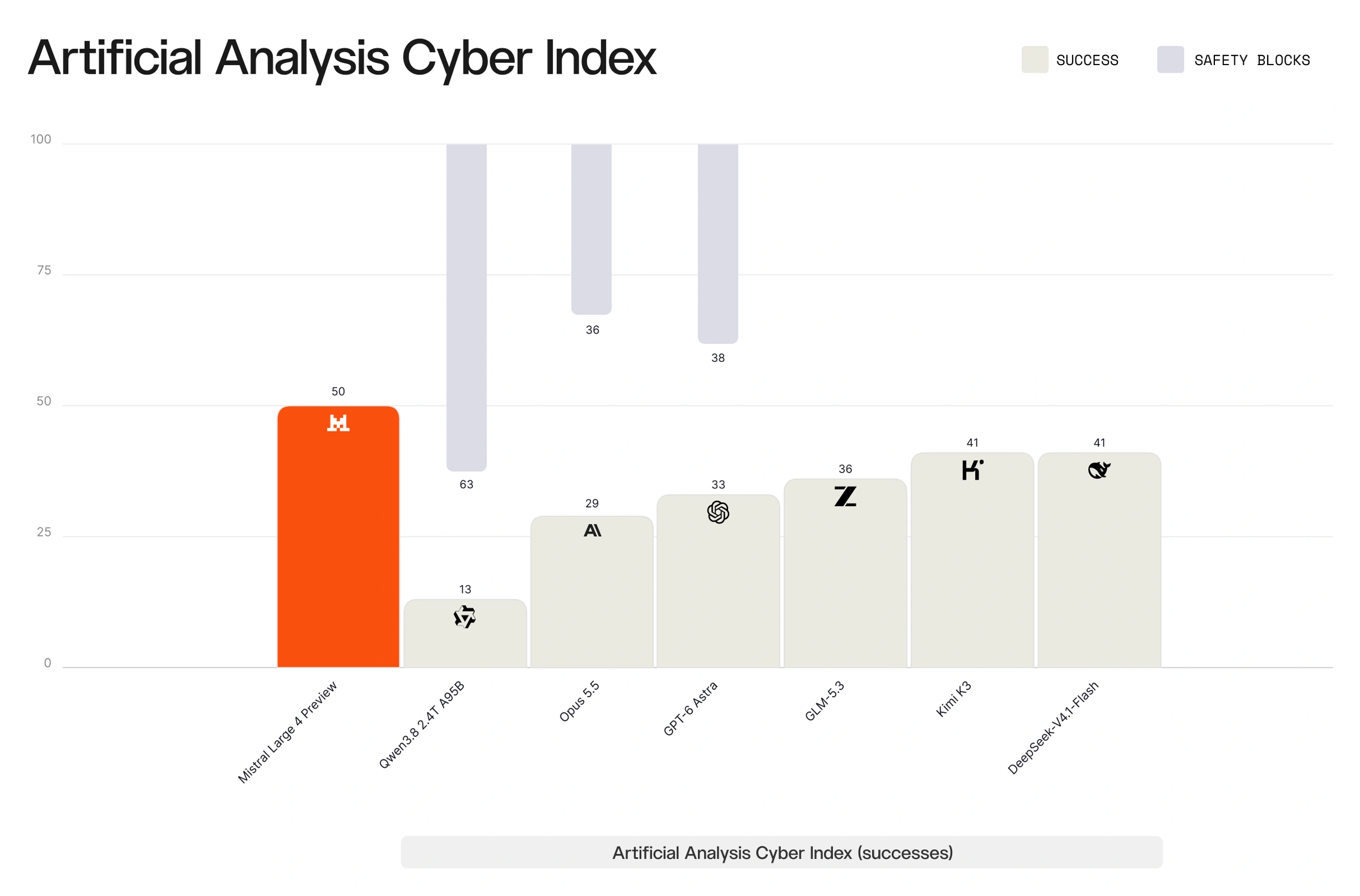
Cybersecurity. On the Artificial Analysis Cyber Index, Mistral reports ML4 among the top five models globally and the leader among open-weight models developed outside China. On one index test — reproduce a real vulnerability in open-source software, then patch it — ML4 scores 82%, which Mistral calls the highest of any model. It reports that several leading closed models score near zero on that same test because they refuse the task.
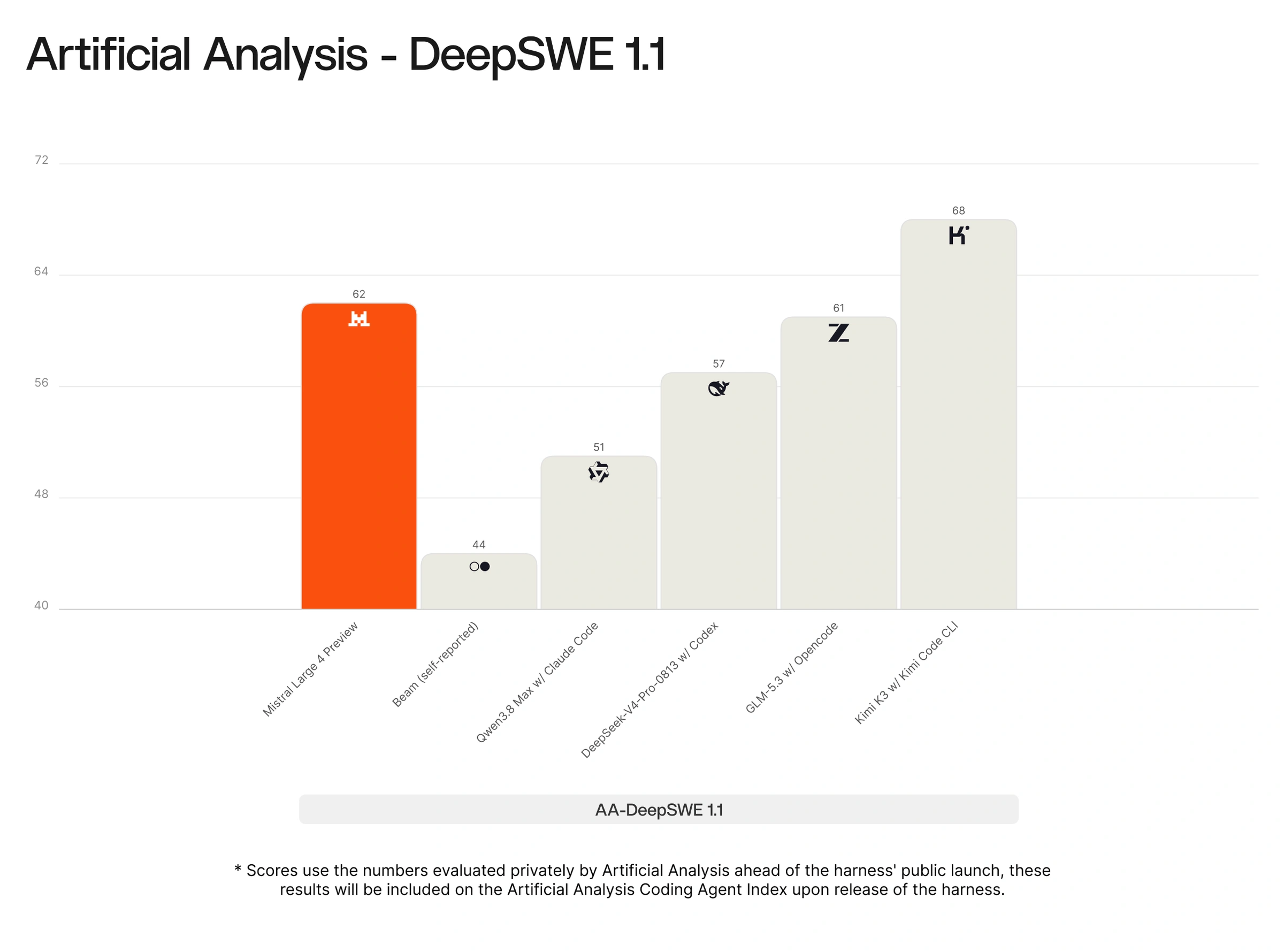
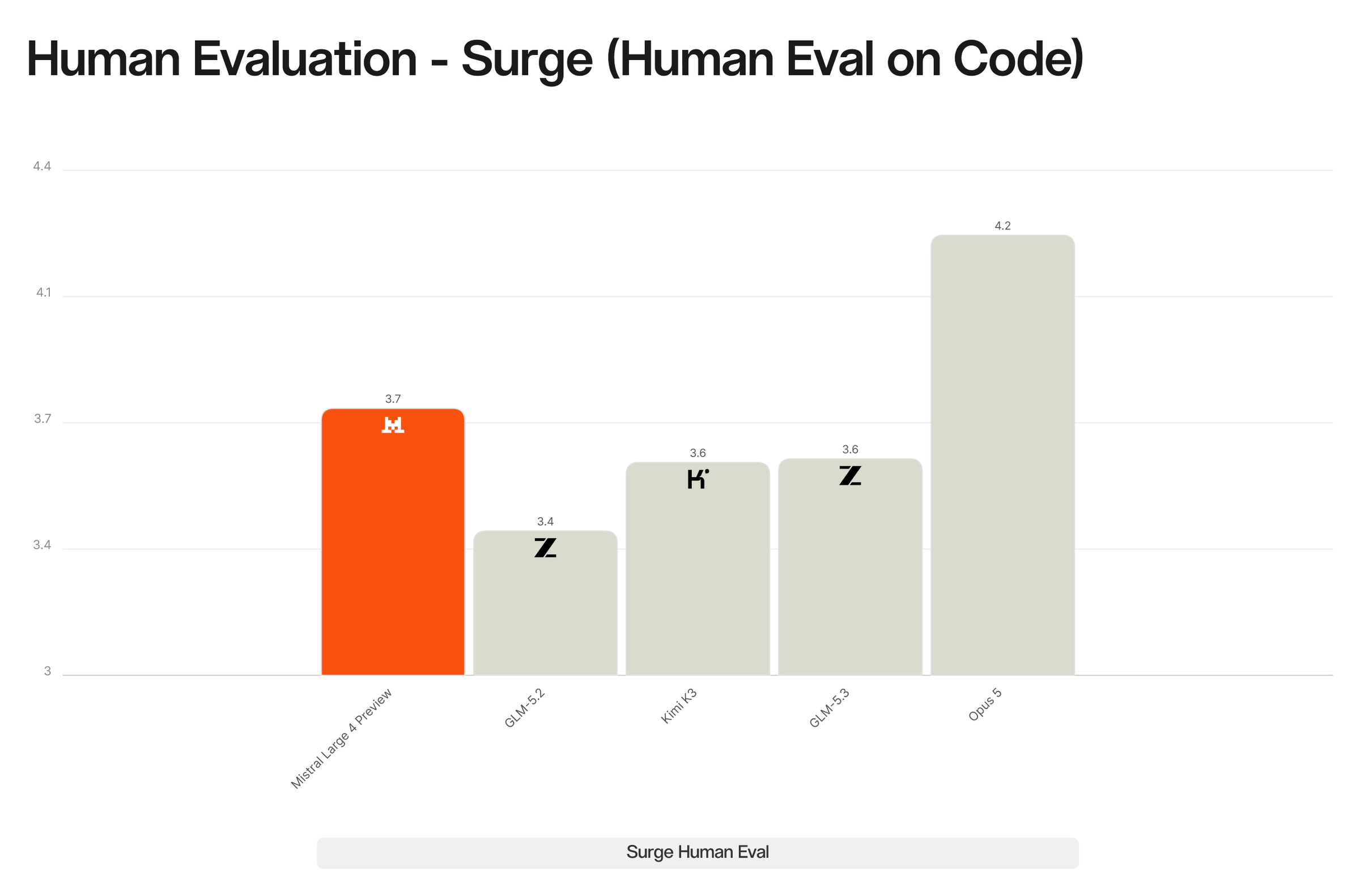
Coding. ML4 scores 61.7% on DeepSWE v1.1, 59.4% on SWE-Atlas-QnA, and 28.3% on Terminal-Bench 4, with a combined Coding Agent Index of 49.8% — ahead of DeepSeek V4 Pro 0813 and Qwen3.8 Max, per Mistral. In a blind evaluation run with Surge AI, annotators rated the preview second of five models at 3.74 out of 5, behind Claude Opus 5 (4.22) and ahead of GLM-5.3 (3.60) and Kimi K3 (3.59).
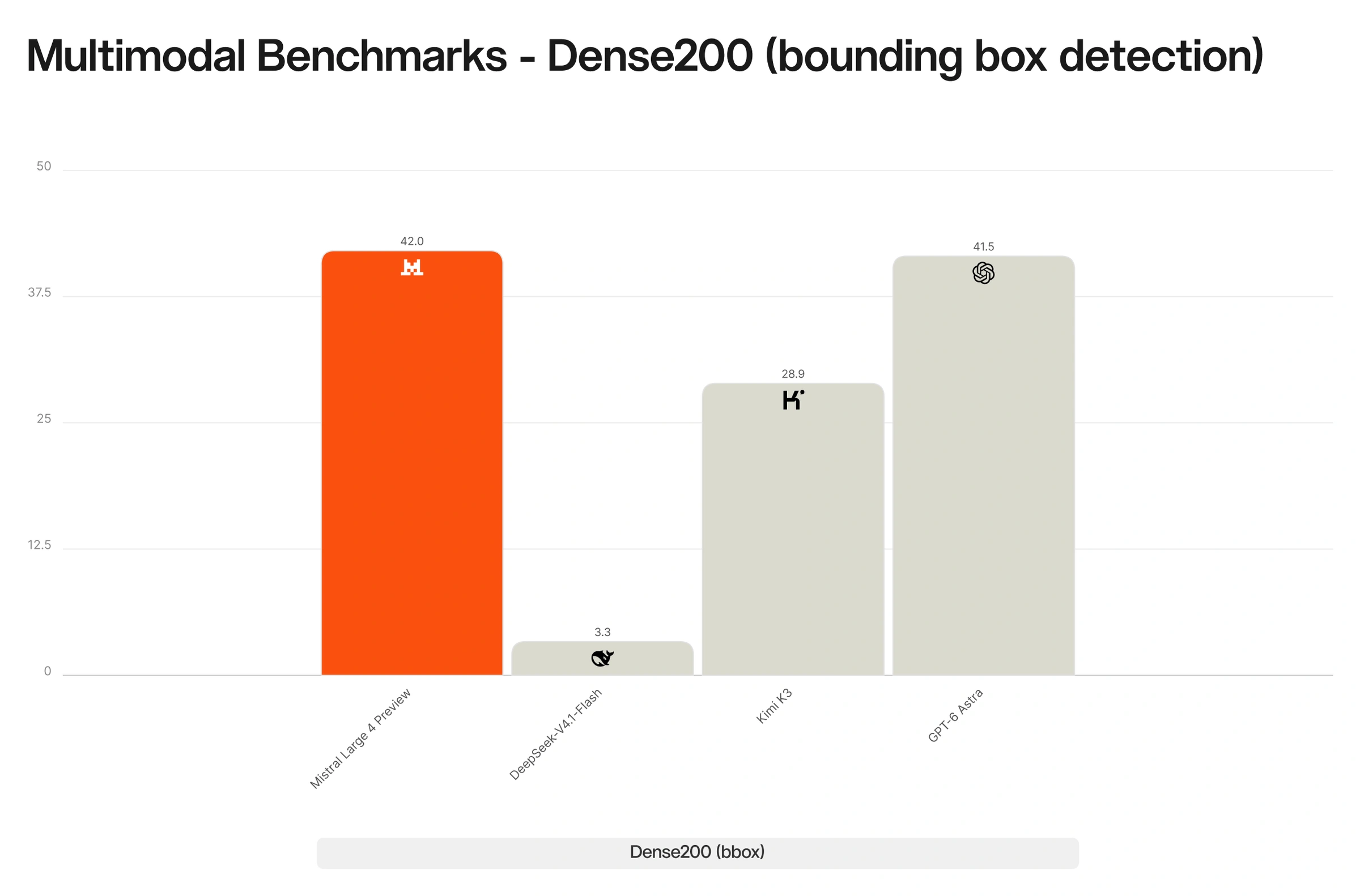
Vision. Mistral calls the image capabilities a step change, with reasoning over documents, charts, technical drawings, and satellite imagery. On visual grounding it reports 42% on Dense 200 against 41.5% for GPT-6 Astra — a narrow but symbolically notable win over a closed frontier model. Third-party vals.ai evaluations on legal and financial tasks also put the preview ahead of GPT-6 Astra, though its absolute score on Harvey’s Legal Agent Benchmark stays low at roughly 15%.
Independent evaluator Artificial Analysis scores the preview 38 on its Intelligence Index with reasoning — up sharply from 9 for the non-reasoning Mistral Large 3, but still behind Chinese open-weight models GLM-5.3 (45) and Kimi K3 (44) at maximum reasoning settings. It also notes the model is verbose, generating 200 million output tokens during evaluation against a median of 81 million for comparable reasoning models.
Open Weights, Unresolved Details
The most important detail is one Mistral has not yet settled: the license. Predecessor Mistral Large 3 shipped under Apache 2.0, but Mistral has not announced terms for ML4, which is why Artificial Analysis currently lists the preview as proprietary. Until the weights actually ship, the “open” in open-weight is a promise rather than a fact.
Pricing on the preview API has been reported around $0.68 per million input tokens and $2.09 per million output tokens, with at least one listing showing higher figures ($1.36/$4.18). Reporters including AFP and Journal du Net put the expected weights release at October 27, alongside architecture details, extra benchmarks, and Mistral’s post-training methodology.
Mistral also stresses that the model is still training: the reinforcement learning run behind the preview “is still in flight, and the model is showing no signs of saturation.” At current scale (about 3,000 GPUs), it says a single training run produces roughly 33 billion tokens per day, around 16 billion of them trainable after filtering and masking.
What This Means
ML4 lands in a different competitive frame than earlier Mistral releases. The frontier-tier open-weight conversation has been dominated by Chinese labs — DeepSeek, Alibaba, Zhipu, Moonshot — and GLM-5.3 and Kimi K3 still lead ML4 on Artificial Analysis’s composite index. Mistral’s pitch is not that it has out-scaled them, but that it offers a European, self-hostable alternative with particular strength in cybersecurity and vision, where refusals in closed models can block legitimate defensive work.
Two things are worth watching. First, the weights and license: the gap between an Apache-2.0 drop and a restricted release changes the entire deployability calculus. Second, independent reproduction — most headline numbers are vendor-reported, and Mistral chose the comparison models and charts. The Surge AI, vals.ai, and Artificial Analysis figures are the most useful third-party anchors so far, and they tell a more measured story than the launch charts alone.
Related Coverage
- Mistral Medium 3.5 Launches with Vibe Remote Coding Agents — Mistral’s April 2026 frontier-tier release and cloud agent system
- Mistral Small 4: Four Models Unified in One Open-Source MoE — the sparse MoE approach that scales up into Large 4
- GLM-5.3 Post-Training Scales Cyber Capabilities — the open-weight model Mistral is measured against on cyber and index scores
- Opus 5.5 Tops Artificial Analysis — the closed frontier model at the top of the same leaderboard
This post was drafted with AI assistance and reviewed by RITS staff.
Sources
- Introducing Mistral Large 4 — Mistral AI
- Mistral Large 4 — Mistral Docs
- France’s Mistral announces new AI model — CNA (AFP)
- Mistral launches open-source Mistral Large 4, details AI roadmap — SiliconANGLE
- Mistral AI launches Large 4 preview ahead of open-weight release — AI News
- Mistral Large 4 benchmarks, cost and capabilities — Vals AI
- Mistral Large 4: benchmarks, pricing, speed and rank — BenchLeader