Lead — On October 13, 2026, Fish Audio released Drama 3, a 35-billion-parameter open-weight text-to-speech model that follows plain-language acting directions instead of selecting from a fixed menu of emotion presets. The weights are published on Hugging Face and GitHub under the Fish Audio Community License v1.0, and the model is served from launch day by SGLang-Omni. According to its technical report, Drama 3 is the largest open-weight model dedicated to speech generation by total parameter count.
Intermediate
Key points
- On October 13, 2026, Fish Audio released Drama 3, a 35-billion-parameter open-weight text-to-speech model that takes plain-language acting directions rather than preset emotions.
- The model’s weights are published on Hugging Face and GitHub under the Fish Audio Community License v1.0.
- According to its technical report, Drama 3 is the largest open-weight model dedicated to speech generation by total parameter count.
- On Artificial Analysis’ Pronunciation Robustness benchmark, Drama 3 scored 93.2%, first on the board ahead of Eleven v4 at 91.7%.
- A review by eesel notes Drama 3 placed tenth, not first, on Artificial Analysis’ preference-based Speech Arena.
Directing a Line Instead of Picking an Emotion
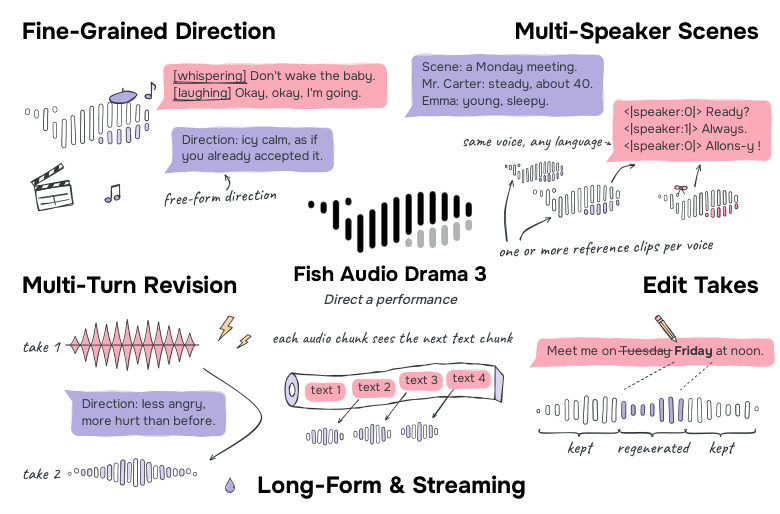
The control surface is text. A direction goes in square brackets at the point in the line where it should land, written the way a director would brief an actor: [slow, dangerously quiet] Just one. A sound effect or a pause is placed the same way, as in I'm fine. [shaky breath] Really. Paired tags such as <whisper>…</whisper> scope a change to specific words, and phoneme tags using CMU Arpabet, pinyin or romaji pin the pronunciation of a single term.
Three things are new relative to Fish Audio’s earlier S2 line. First, multi-turn revision: after hearing a take, you send a note on the next turn — Fish Audio’s example is [softer and warmer versus previous] — and the model redoes the line with the earlier takes still in context. Second, editing by infilling: mark a word inside an existing take, type the replacement, and only that word is regenerated to fit the surrounding voice, mood and pace. Third, scene dubbing: speaker tags <|speaker:0|> through <|speaker:15|> let one request carry up to 16 characters, each cast from its own reference clip, in a single pass. A character’s lines can even switch languages while keeping the same voice.
Drama 3 speaks 83 languages, and the direction does not have to be in the language of the line — you can write the note in Chinese, Spanish or Japanese and still direct an English sentence. The API is the same endpoint as S2.1 Pro, so switching an existing integration is one header change to model: drama-3. One caveat worth noting, raised in a review by eesel: if that header is misspelled, the request does not fail — it silently falls back to S2.1 Pro, and you are billed without ever running Drama 3.
What the Benchmarks Show
The headline number is pronunciation, not emotion. On Artificial Analysis’ Pronunciation Robustness benchmark, where human reviewers check whether brand names, context-dependent words, numbers and exact sequences such as file paths are read correctly, Drama 3 scored 93.2% — first on the board, ahead of Eleven v4 at 91.7%, Eleven v4 Turbo at 90.1% and Google’s Gemini 3.8 Flash TTS at 89.5%. Fish Audio’s own comparison with the previous generation is the largest gap: 93.2% against 88.1% for S2.1 Pro, with the biggest gains on brand and technical terms (95.9% vs 87.3%) and context-dependent words (95.3% vs 86.1%).
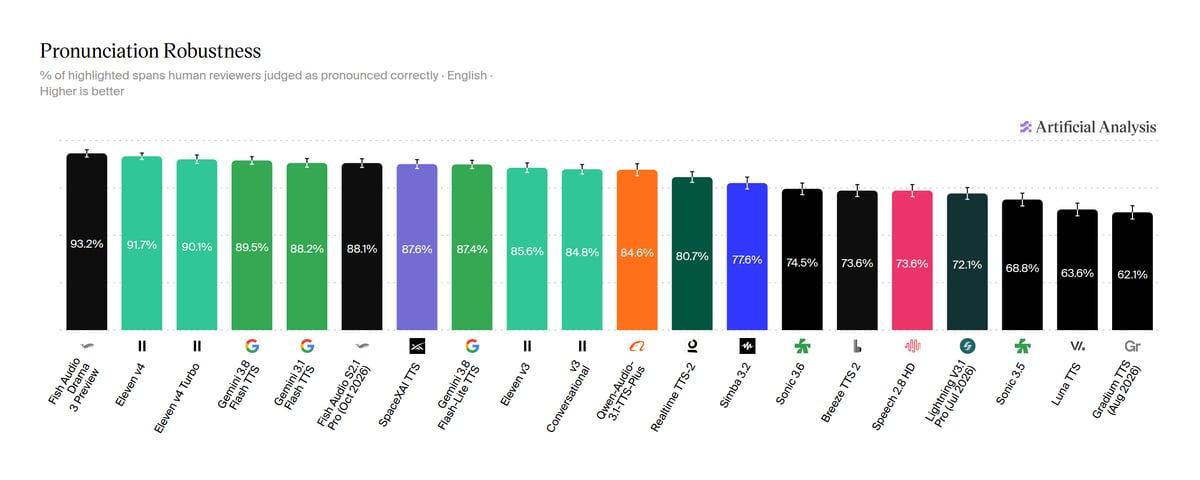
Two caveats belong next to that chart. Pronunciation accuracy is a different measurement from whether listeners prefer the voice: the same eesel review notes that Drama 3 placed tenth, not first, on Artificial Analysis’ preference-based Speech Arena, and Artificial Analysis’ own summary page currently lists Eleven v4 Turbo as the highest-quality model overall. Separately, the technical report claims the lowest error rate among compared systems for zero-shot cloning in Chinese, Dutch, English, German and Turkish on the MiniMax Multilingual Testset, and a lower error rate than Cartesia Sonic-3’s infill API on the Ming-Freeform-Audio-Edit benchmark in English and Chinese — both are the authors’ own evaluations.
How Drama 3 Works
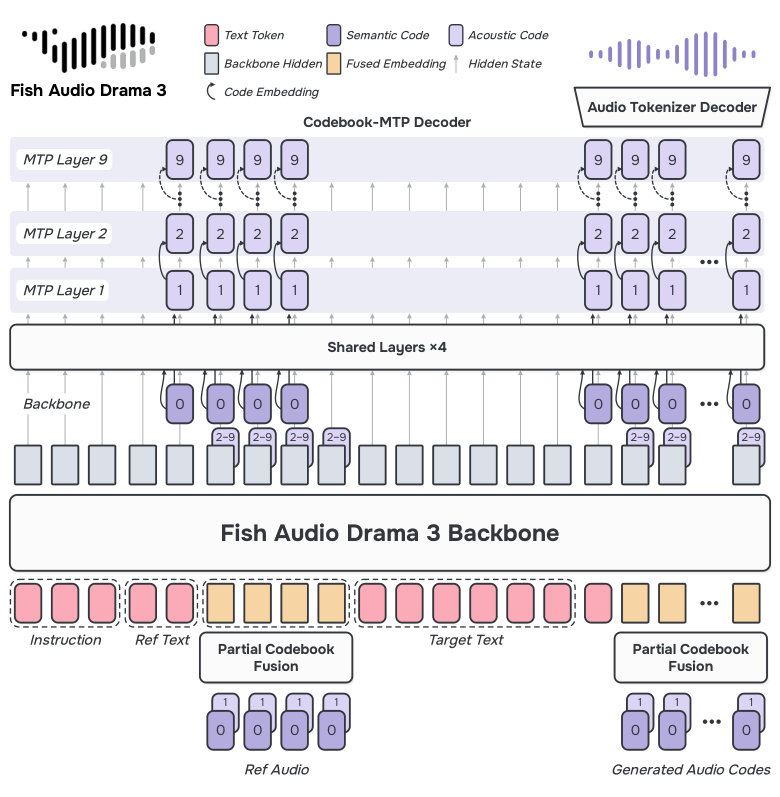
The backbone is a sparse mixture-of-experts model of 35B parameters that activates roughly 3B per token — 8 of 256 routed experts plus one shared expert — initialised from the language model of Qwen3.5-35B-A3B. Its 40 layers are arranged in blocks of three Gated DeltaNet layers and one gated full-attention layer, so only one layer in four keeps a KV cache and long directed sessions, with their reference clips and earlier takes, stay affordable.
The more interesting change is the audio decoder. S2 used a small per-frame autoregressive module that saw the reference audio only through a single summarised backbone state. Drama 3 replaces it with a codebook multi-token-prediction decoder: four shared layers feed nine full-width layers, one per residual codebook, and every layer attends causally over the whole sequence — including the fine acoustic codes of the reference clip. Only codebooks 0 and 1 are fed back into the backbone, which the report describes as a way to limit exposure bias. The tokenizer is unchanged from S2 (Descript Audio Codec, 44.1 kHz, ten codebooks, about 21.5 frames per second).
Training ran in three pre-training stages on several hundred billion tokens (sequences growing from 8K to 16K tokens), then instruction fine-tuning, then reinforcement learning. The RL stage is the conceptual pivot. TTS models are usually rewarded for low word error rate and high speaker similarity, but a laugh, a long pause or a whisper legitimately breaks both of those proxies. Drama 3 drops every rule-based reward and optimises a single learned model of human preference using GRPO without a KL penalty, on batches of 1,536 prompts with 8 takes each.
Serving It
The released checkpoint keeps the MoE experts in FP8 with the rest of the weights in bf16, for 37.0 GB of weights. A community int4 GPTQ build cuts that to 20.8 GB with word error rate holding at the FP8 level (1.63% versus 1.99% on Seed-TTS English at concurrency 8) at roughly 8% slower per request — inside run-to-run variance of a single checkpoint. On one H200, SGLang-Omni gets a first audio chunk in a median 88.9 ms for a single stream and generates 678 frames per second at concurrency 8, with real-time factor still at 0.80 at concurrency 64. The technical report notes a single stream decodes at 271 frames per second, against 177 for S2, despite Drama 3 having more than seven times the parameters. Because vocoder placement is deployment configuration rather than model code, moving the vocoder to a second GPU raised throughput from 2,422 to 4,160 frames per second at 256 concurrent streams and cut median time-to-first-audio by about 37%. References are capped at 60 seconds each, prompts at 8,192 rows, and the engine runs only on the Triton attention backend.
What This Means
For most of the last two years, expressive TTS control has meant making a choice inside someone else’s taxonomy: pick an emotion tag, pick a style preset, set a stability slider. Drama 3’s direction scheme moves that control into the script itself, where a writer already works, and multi-turn revision and infilling matter as much as the voice quality does — they are the difference between an audiobook workflow and a demo. The RL change is the part worth watching: dropping word-error and similarity rewards in favour of a single preference model is a bet that expressiveness and intelligibility can be traded against each other on purpose rather than by accident.
The open weights come with real friction. The Fish Audio Community License v1.0 is free for commercial use only below US$500,000 in annual revenue (for you and your affiliates), and offering Drama 3 as a TTS, cloning or inference service requires a separate licence regardless. The licence also prohibits cloning a real person’s voice without consent. On the hardware side, 37 GB of weights plus KV cache is a datacentre-class footprint, not a laptop one. And pricing is promotional: US$10 per million characters until November 12, against a US$50 list price. The pragmatic read from early reviewers is that Drama 3 is the strongest open-weight TTS model available to download today, best suited to scripted lines you render once and keep — audiobooks, audio drama, game dialogue — rather than live, high-volume voice work where take-to-take variation is a liability.
Related Coverage
- Voxtral TTS: Mistral’s Open-Weight Text-to-Speech Model Rivals ElevenLabs — a 4B open-weight TTS model aimed at the same hosted-voice market
- Google Releases Gemini 3.1 Flash TTS with 200+ Audio Tags — the closed-model approach to fine-grained delivery control
- Qwen3.5-Omni: Alibaba’s Omnimodal AI Speaks 36 Languages and Codes from Voice — voice cloning inside a general omni-modal model
- NVIDIA Releases NemotronLabs VoiceChat, an Open Full-Duplex Voice Model — open speech models moving in the conversational direction
This post was drafted with AI assistance and reviewed by RITS staff.
Sources
- Fish Audio Drama 3 Technical Report (arXiv:2610.18010) — architecture, training recipe, inference engine and evaluations
- Fish Audio launch post: “Fish Audio Drama 3: The Most Emotive Text-to-Speech Model We’ve Built” (October 13, 2026)
- fishaudio/drama-3 model card — weights, speaker tags and licence
- SGLang-Omni cookbook: Fish Audio Drama 3 — deployment, serving limits, int4 checkpoint and production benchmarks
- Artificial Analysis: Text to Speech leaderboard and Pronunciation Robustness methodology
- eesel review: “Fish Audio Drama 3 review: the best open TTS model, with three catches” (October 14, 2026)