DeepSeek has launched V4, its newest flagship open-source language model, exactly one year after the V3/R1 releases that rattled Silicon Valley. Announced on April 24, 2026, the V4 family ships in two Mixture-of-Experts variants — a 1.6-trillion-parameter V4-Pro and a leaner 284-billion-parameter V4-Flash — both supporting a 1-million-token context window and both released with open weights under permissive licenses.
Intermediate
Key points
- DeepSeek announced V4 on April 24, 2026, in two Mixture-of-Experts variants: the 1.6-trillion-parameter V4-Pro and the 284-billion-parameter V4-Flash, both with a 1-million-token context window and open weights under permissive licenses.
- Both models support up to 1 million input tokens and up to 384K tokens of output, with weights available on Hugging Face.
- Published API pricing is $1.74 / $3.48 per million input/output tokens for V4-Pro and $0.14 / $0.28 for V4-Flash, roughly an order of magnitude below comparable closed frontier models.
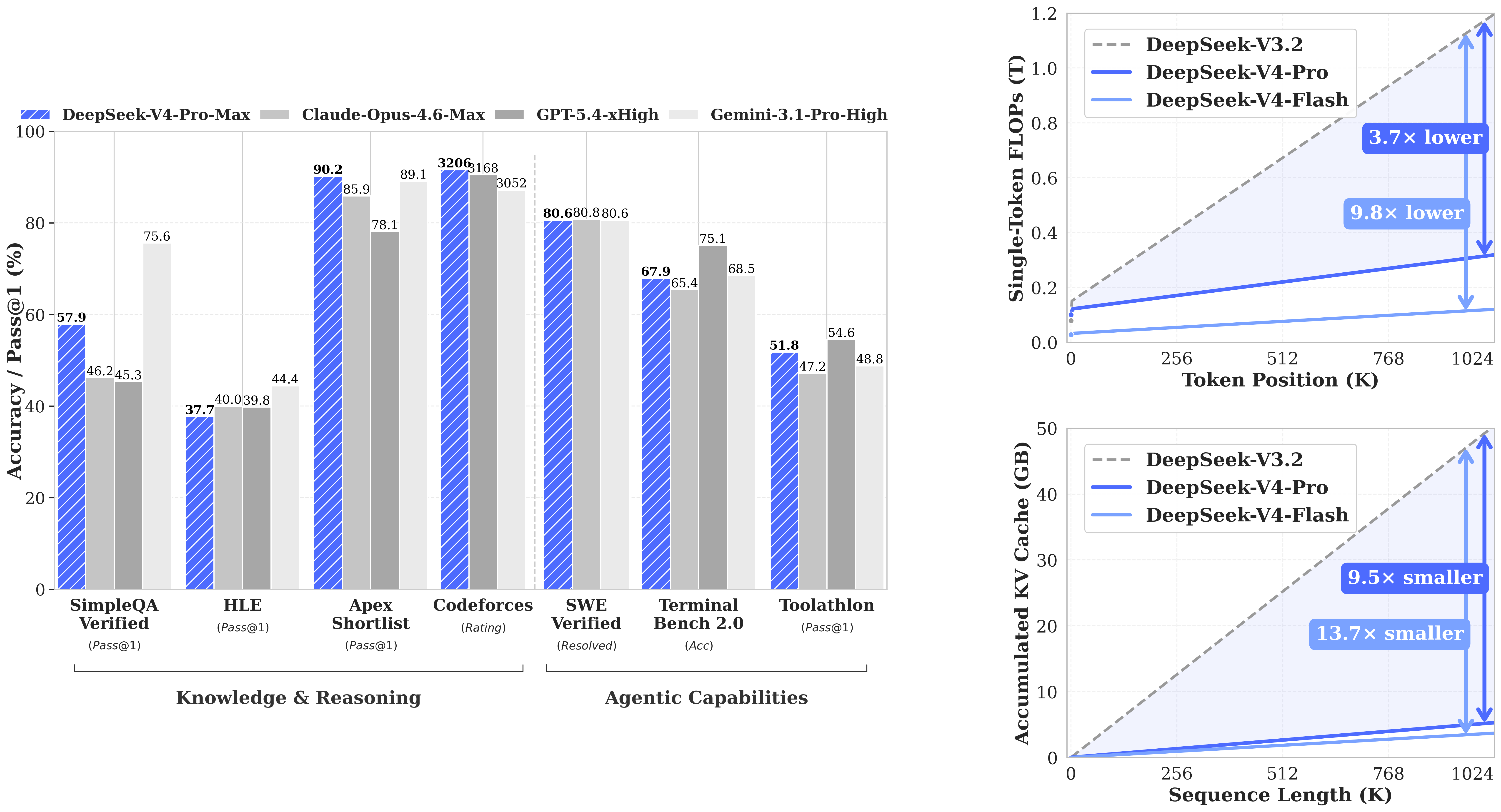
- At 1M-token context, V4-Pro reports needing only 27% of the single-token inference FLOPs and 10% of the KV cache of V3.2.
- On DeepSeek’s published scorecards, V4-Pro-Max reports LiveCodeBench 93.5% against Kimi K2.6 at 89.6%, and a Codeforces rating of 3206 against GPT-5.4 at 3168.
What Was Released
The V4 series comprises two MoE language models that share the same core architecture but target different deployment budgets:
- DeepSeek-V4-Pro — 1.6T total parameters, 49B activated per token.
- DeepSeek-V4-Flash — 284B total parameters, 13B activated per token.
Both models support up to 1 million input tokens and up to 384K tokens of output. Weights are available on Hugging Face, and the API is live at DeepSeek-compatible endpoints that speak both the OpenAI ChatCompletions and Anthropic protocols. Published API pricing is $1.74 / $3.48 per million input/output tokens for V4-Pro and $0.14 / $0.28 for V4-Flash — roughly an order of magnitude below comparable closed frontier models.
Architecture and Efficiency Gains
DeepSeek describes V4 as a genuine generational step rather than a refresh of V3.2. Three ideas drive the jump:
- Hybrid Attention — V4 combines Compressed Sparse Attention (CSA) with Heavily Compressed Attention (HCA) to keep long-context inference tractable. At 1M-token context, V4-Pro reports needing only 27% of the single-token inference FLOPs and 10% of the KV cache of V3.2.
- Manifold-Constrained Hyper-Connections (mHC) — a residual-propagation scheme that DeepSeek says stabilizes signal flow through very deep MoE stacks.
- Muon optimizer + FP4/FP8 mixed precision training — MoE experts are trained in FP4 while most other parameters use FP8. The model was pre-trained on more than 32 trillion tokens.
V4 also exposes three reasoning modes: non-think for fast responses, think-high for conscious logical analysis, and think-max for the model’s full chain-of-thought budget (DeepSeek recommends pairing think-max with 384K+ token context).
Benchmarks
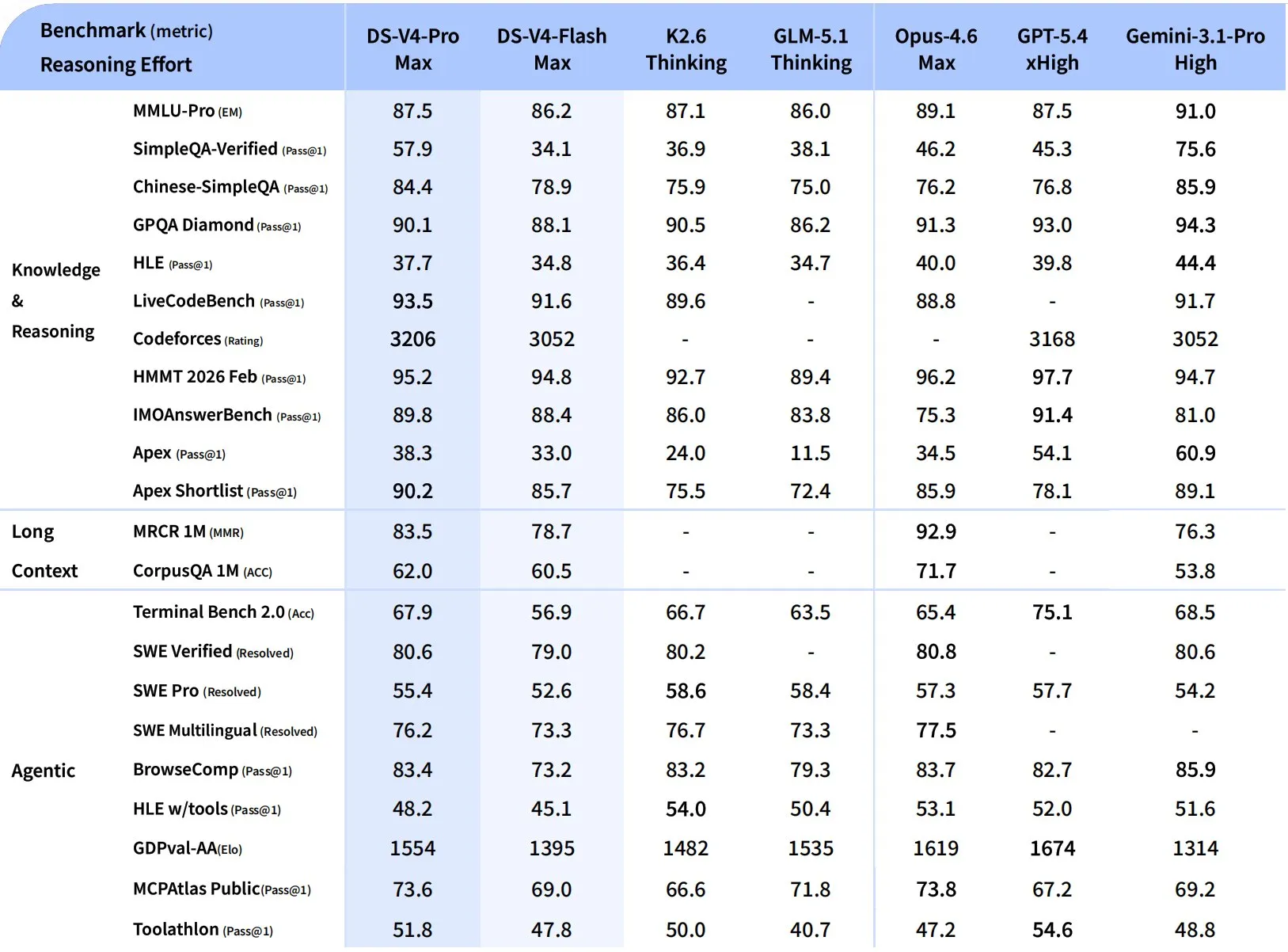
On the scorecards DeepSeek published alongside the release, V4-Pro-Max posts numbers that are competitive with — and in places ahead of — proprietary frontier systems:
- MMLU-Pro: 87.5%
- SimpleQA-Verified: 57.9%
- LiveCodeBench: 93.5% (vs. Kimi K2.6 at 89.6%)
- Codeforces rating: 3206 (vs. GPT-5.4 at 3168)
- HMMT 2026 Feb (math): 95.2%
- MRCR 1M (long-context recall): 83.5%
- SWE-bench Verified: 80.6%
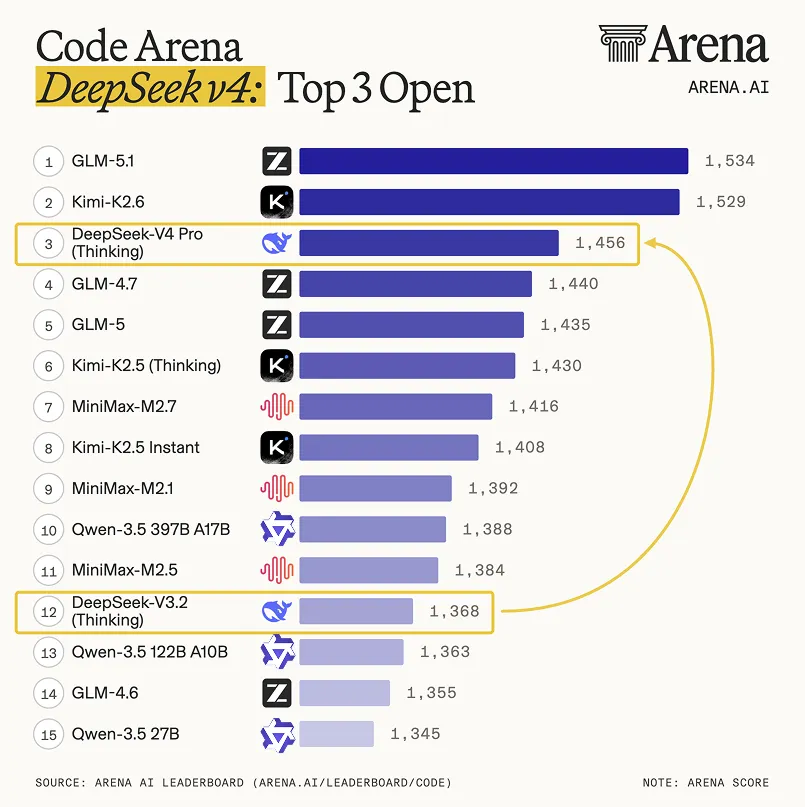
On the LM-Arena Code leaderboard, V4-Pro Thinking currently sits at #3 among open models with an Elo of 1,456 — an 88-Elo gain over V3.2. V4 still trails Anthropic’s Opus 4.6 on MRCR 1M long-context recall (92.9%) and trails Kimi K2.6 on the newer SWE-bench Pro.
What This Means
V4 sharpens the pattern DeepSeek established with V3 and R1: ship an open-weights model whose reported benchmarks sit in the same neighborhood as closed frontier systems, at a fraction of the API cost, and with architectural ideas (sparse/compressed attention, hyper-connections, FP4 expert training) that the rest of the community can inspect and adopt. The inference-efficiency claims are particularly consequential — if the 27%-FLOPs and 10%-KV-cache numbers hold at 1M-token context, V4-Pro makes long-context agentic workloads meaningfully cheaper to serve than prior-generation MoE designs.
Questions worth watching over the next few weeks: how the independent reproductions of LiveCodeBench and SWE-bench numbers land, how V4-Flash performs on commodity GPUs, and how quickly the Hugging Face weights show up in hosted-inference providers. The April 24 announcement is the starting gun, not the finish line.
Related Coverage
- Anthropic Exposes Industrial-Scale Distillation Attacks by DeepSeek, Moonshot, and MiniMax — February 2026 disclosure that touched off a new round of debate over how Chinese labs train their models.
- DeepSeek Unveils DeepSeekV3.1 Terminus — the September 2025 V3.1 update that set the baseline V4 is being measured against.
- DeepSeek-V3.1 Enhances AI Capabilities with Anthropic API Compatibility — the dual-protocol API pattern V4 continues.
This post was drafted with AI assistance and reviewed by RITS staff.
Leave a Reply