On June 3, 2026, Ideogram released Ideogram 4.0 — its first open-weight text-to-image foundation model. The 9.3-billion-parameter model ships with both weights and inference code under a non-commercial license, and immediately took the top spot among open-weight models on the DesignArena leaderboard. Built from scratch around a single-stream Diffusion Transformer and a structured JSON prompting interface, it targets the part of image generation that most models still fumble: typography, layout, and design-grade text rendering.
Advanced
Key points
- On June 3, 2026, Ideogram released Ideogram 4.0, which it describes as its first open-weight text-to-image foundation model.
- The 9.3-billion-parameter model ships weights and inference code under a non-commercial license and took the top spot among open-weight models on DesignArena.
- Its architecture is a fully single-stream Diffusion Transformer with 34 layers, concatenating text and image tokens into one unified sequence.
- Text conditioning uses Qwen3-VL-8B-Instruct, with features extracted from 13 intermediate layers instead of a single final embedding.
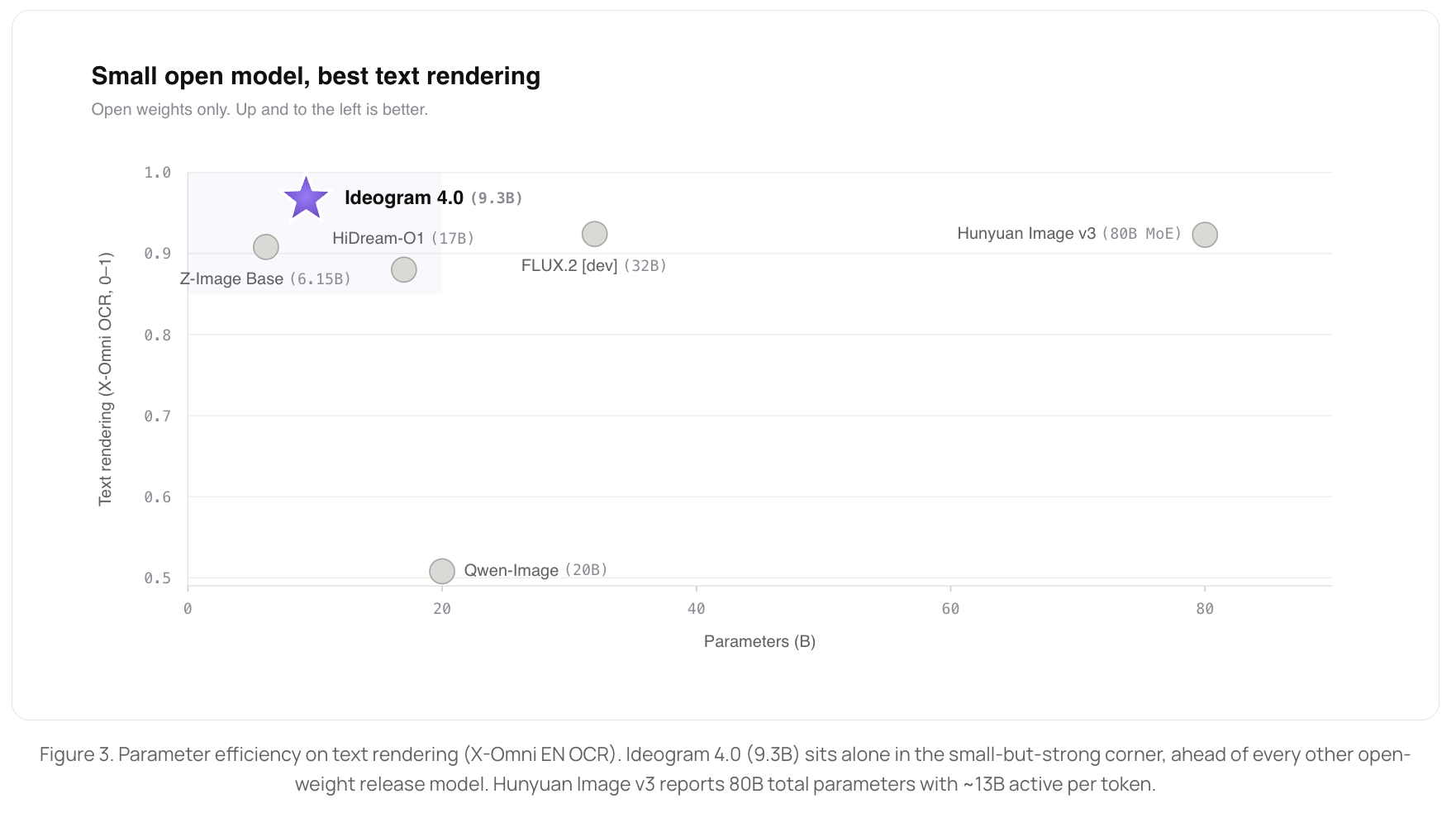
- Ideogram reports a 0.97 score on the X-Omni English OCR benchmark, claiming it beats larger models like Qwen-Image (20B), FLUX.2 dev (32B), and HunyuanImage (80B MoE) at 9.3B parameters.

Architecture
Ideogram 4.0 is a foundation model trained from scratch — not a fine-tune of an existing checkpoint. At its core is a fully single-stream Diffusion Transformer (DiT) with 34 layers, where text and image tokens are concatenated into one unified sequence rather than processed in separate streams. This lets the model perform deep cross-modal interaction between what the prompt says and what the canvas looks like at every layer.
Text conditioning comes from Qwen3-VL-8B-Instruct, a vision-language model whose features are extracted from 13 intermediate layers rather than a single final embedding. Generation is steered by dual-branch classifier-free guidance, which independently refines the conditional and unconditional paths. The model supports native output from 256 to 2048 pixels (in multiples of 16) and flexible aspect ratios up to 6:1 — wide enough for banners and headers in a single pass.
Benchmarks
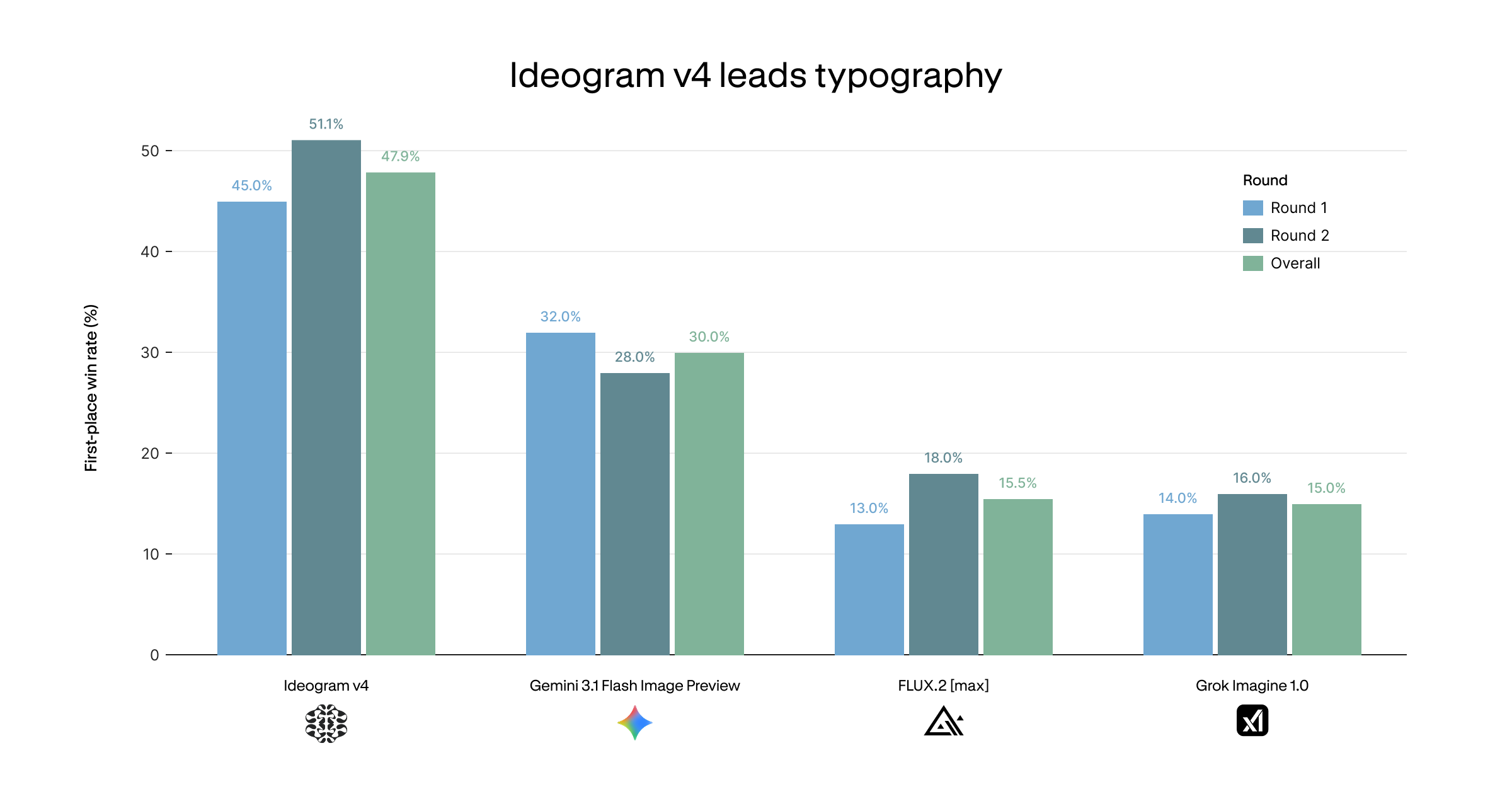
The headline claim is text accuracy. Ideogram reports a 0.97 score on the X-Omni English OCR benchmark, and the model outperforms substantially larger competitors on text rendering — including Qwen-Image (20B), FLUX.2 dev (32B), and HunyuanImage (80B MoE) — at just 9.3B parameters. On the ContraLabs typography evaluation it posts a 47.9% first-place win rate and a 3.55/5 usability rating for client work, leading the open-weight field.
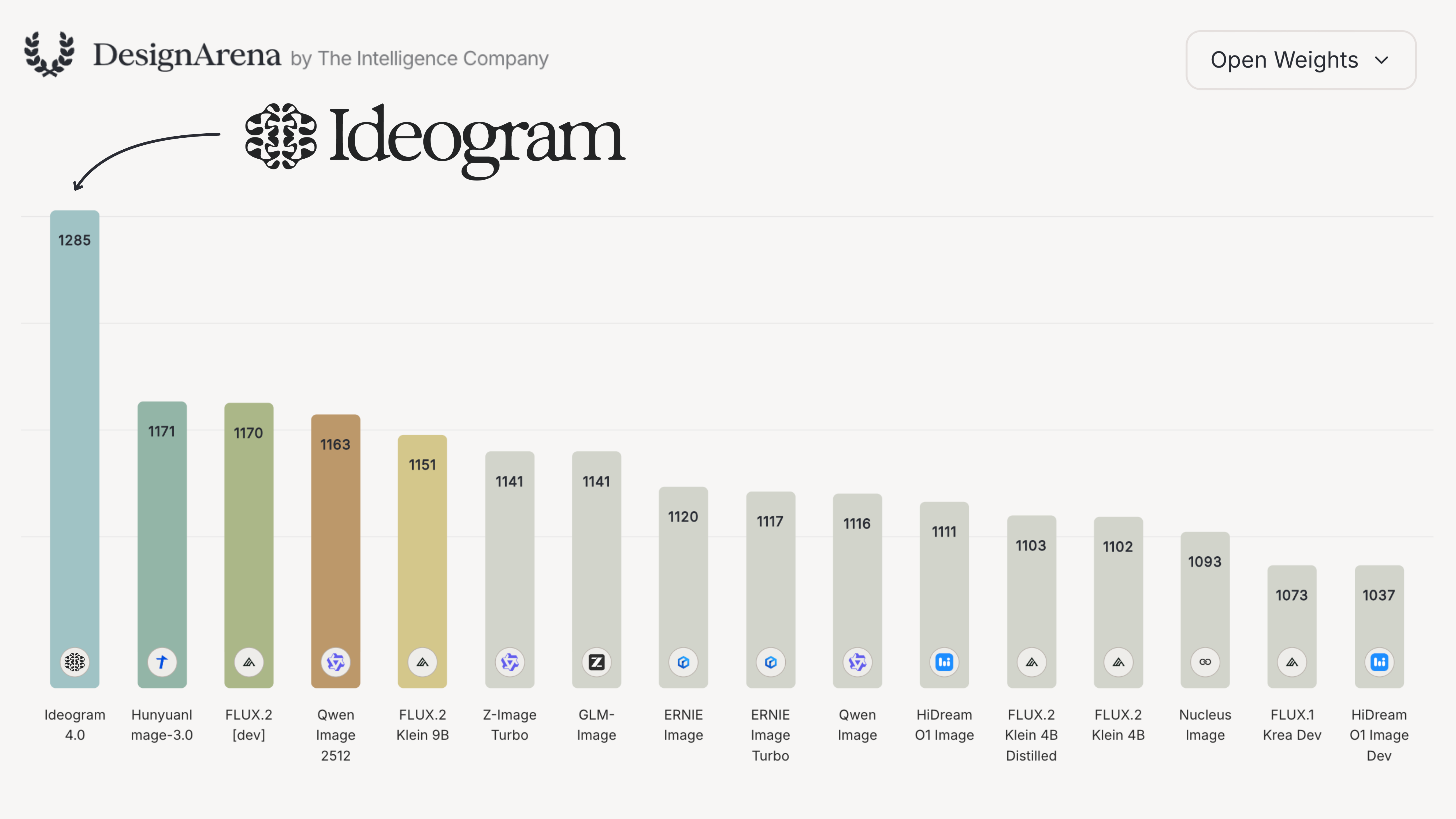
On DesignArena, Ideogram 4 ranks as the top open-weight model, trailing only proprietary systems from OpenAI and Google. It also leads open-weight entries on LMArena (top-5 overall) and beats all closed-source models on the 7Bench layout benchmark. The parameter-efficiency picture is the more striking story: against models several times its size, Ideogram 4 sits at the favorable corner of the quality-versus-size curve.
JSON Prompting
The most distinctive feature is how you talk to the model. Ideogram 4 was trained exclusively on structured JSON captions, and its prompt interface exposes that directly. Instead of a free-text string, you can supply a JSON object describing the scene compositionally:
{
  "colour_palette": ["#0A1F44", "#F2A900", "#FFFFFF"],
  "compositional_deconstruction": [
    {
      "element": "headline text reading 'OPEN WEIGHTS'",
      "bbox": [0.1, 0.1, 0.9, 0.3]
    },
    {
      "element": "geometric logo mark, centered",
      "bbox": [0.4, 0.5, 0.6, 0.7]
    }
  ]
}
The colour_palette array steers the color scheme with hex values, while bbox coordinates place elements at precise normalized positions. The model validates the JSON structure before generation and uses it directly during inference, which makes complex layouts far more predictable than coaxing a free-text model. Plain-text prompts still work — they are auto-expanded by a “magic prompt” LLM via Ideogram’s API — but the JSON path is where the layout control lives.
Running It
Ideogram ships two quantized releases: ideogram-4-nf4 (nf4, CUDA-only, Diffusers-compatible) and ideogram-4-fp8 (fp8, all hardware), both gated on Hugging Face. With quantization, inference runs on consumer GPUs. A minimal run looks like:
python run_inference.py \
  --prompt "a ginger cat wearing a tiny wizard hat reading a spellbook" \
  --output out.png \
  --quantization "nf4" \
  --height 2048 --width 2048 \
  --sampler-preset V4_QUALITY_48
An IDEOGRAM_API_KEY is needed only for the magic-prompt expansion step (free tier available), and optional Hive moderation keys can be wired in for content filtering.
What This Means
The open-weight image space has trended toward ever-larger models. Ideogram 4 argues the opposite: at 9.3B it beats 20B–80B competitors on the metrics that matter for design — text fidelity and layout control — while running on hardware designers actually own. The structured JSON interface is the bet that matters most. It treats image generation less like a slot machine and more like a layout engine, which is exactly what design workflows have wanted. The catch is the non-commercial license: studios can experiment and fine-tune, but shipping client work on these weights requires Ideogram’s hosted API. Still, for researchers and for anyone studying how to make diffusion models render reliable text, having the weights and inference code in the open is a meaningful shift.
Related Coverage
- Google Launches Nano Banana 2: Pro-Quality Image Generation at Flash Speed — the proprietary side of the same design-quality race
- Z-Image: Alibaba’s Efficient 6B Open-Source Image Generation Model — another small open model punching above its parameter count
This post was drafted with AI assistance and reviewed by RITS staff.
Leave a Reply