On October 7, 2026, Liquid AI released two open-weight “decision models”: d1-3B and d1-omni-600M. Unlike the generative Liquid Foundation Models (LFMs) they are built from, neither writes text. Given a state — text, JSON, one or more images, or, for the smaller model, a voice clip of up to 30 seconds — plus a set of named questions, they return calibrated, typed answers in a single forward pass with zero output tokens. The weights are on Hugging Face under the LFM Open License v1.0, with day-one llama.cpp support and a local deployment guide from NVIDIA’s Jetson AI Lab. Liquid AI’s announcement pitches the pair for hardware ranging from a data-centre DGX down to a Jetson Orin Nano.
Advanced
Key points
- Liquid AI released two open-weight decision models, d1-3B and d1-omni-600M, on October 7, 2026.
- Unlike the generative Liquid Foundation Models they are built from, neither model writes text; given a state and named questions they return calibrated, typed answers in a single forward pass with zero output tokens.
- Liquid’s documentation defines three primitives: noul, a yes/no question returning a probability between 0 and 1; choice, a pick-one-from-many returning a distribution over named options; and score, a probability-weighted position on an ordered rubric of two to ten levels.
- Measured end to end on one warm request, d1-3B answers a single question in 8 ms on an NVIDIA RTX 4090 and 9 ms on an AMD MI325X; on the edge it takes 16 ms on a Jetson AGX Thor and 50 ms on a Jetson Orin Nano.
- The LFM Open License v1.0 permits free commercial use only below $10 million in annual revenue, leaving the hosted d1 API as a separate, proprietary product for larger organisations.
What a Decision Model Is
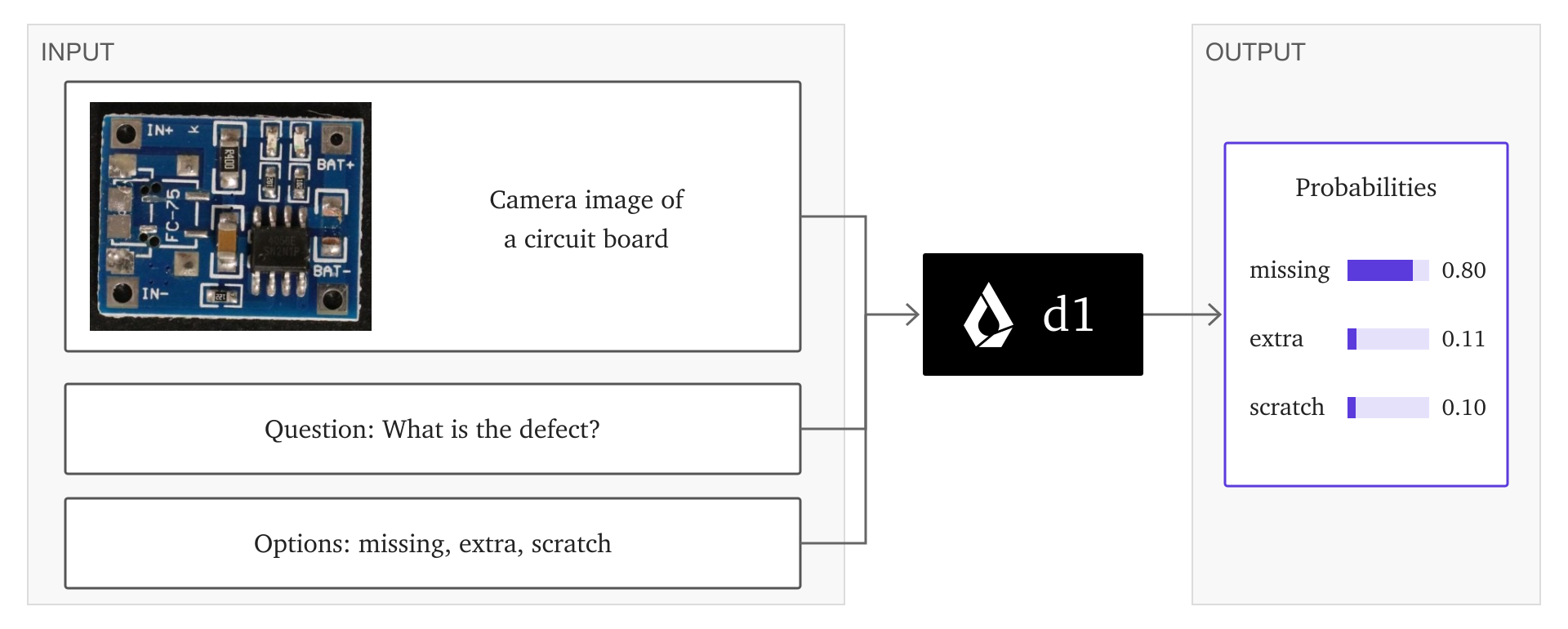
A generative LLM writes an answer token by token and your code parses the string. A decision model instead reads a situation and a set of named questions once and returns a probability for every allowed answer. Liquid’s documentation defines three primitives: noul, a yes/no question returning a probability between 0 and 1; choice, a pick-one-from-many returning a full distribution over named options; and score, a probability-weighted position on an ordered rubric of two to ten levels. Several questions can share one state, so a support ticket can be checked for refund intent, routed to a department and rated for urgency at once — with nothing to parse.
The docs are explicit about where the class does not apply: free-form generation, multi-turn conversation, complex reasoning, summarisation and code generation remain jobs for a language model. The recommended uses are narrower — routing and triage, moderation, intent and topic classification, reranking, LLM-as-a-judge scoring, agent guardrails and visual inspection. With audio input, d1-omni-600M adds voice-command routing.
Two Very Different Backbones
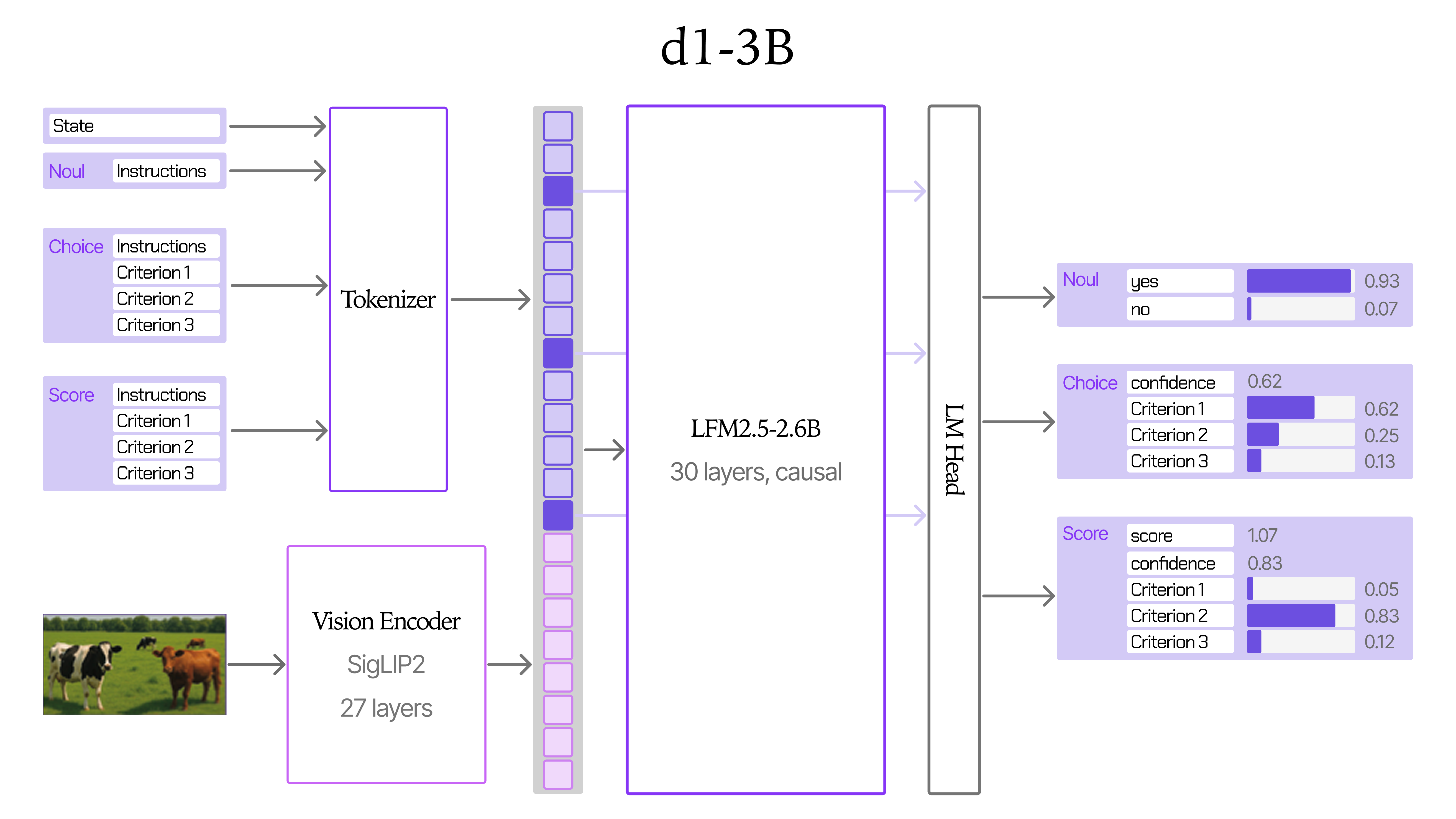
The checkpoints are trained from opposite ends of Liquid’s stack. d1-3B has 3.12B parameters and starts from LFM2.5-VL-3B, a decoder-only vision-language model; it keeps a 400M SigLIP2 NaFlex vision encoder, a 32,768-token context and a 128,000-token vocabulary, and accepts text and images. Liquid averaged the weights of LFM2.5-2.6B with that model’s text backbone, fine-tuned checkpoints under different random seeds and data mixtures, then merged them again — noting that long inputs, shuffled answer options and removing data shortcuts mattered more than any advanced technique.
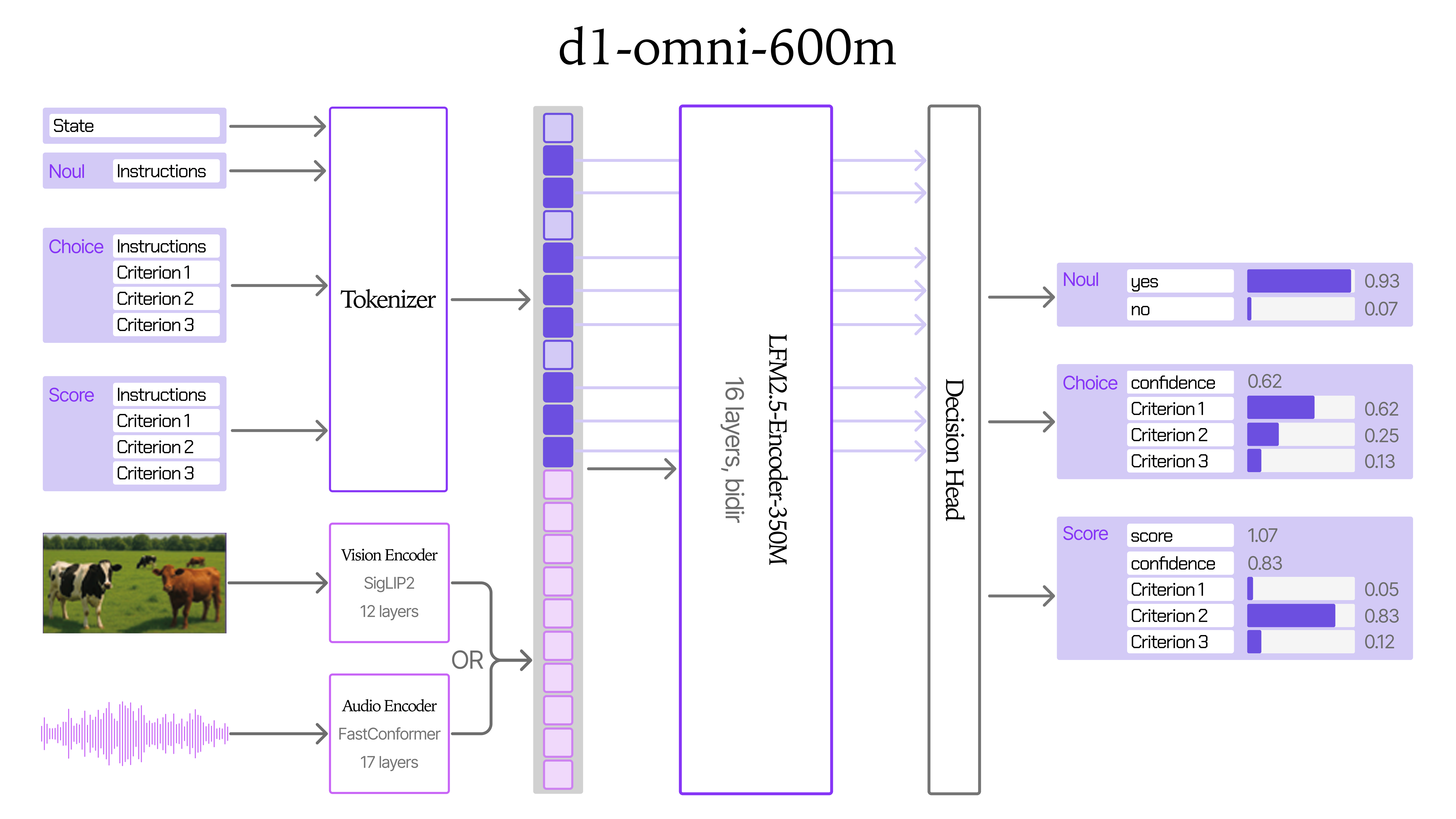
d1-omni-600M heads the other way. Its 587M parameters split into a 381M shared trunk and decision head, a 94M vision encoder and a 112M audio encoder, and the trunk is a bidirectional encoder (LFM2.5-Encoder-350M) rather than a causal decoder. Vision comes from the LFM2.5-VL-450M encoder; audio is a 17-layer FastConformer. Context is 16,384 tokens, and a request carries images or audio, never both. Training was staged — fine-tune the encoder on decisions, then add vision and audio with frozen backbones and adapters, merge the LoRA updates and average the weights. Liquid labels this an early research release and publishes no latency figures for it; its audio training covered English speaker-to-assistant requests only.
Benchmarks and Latency
On the Decision Index v0.2.1, Liquid reports 48.57 for d1-3B — ahead of every model under 10B and level with Decider 35B-A3B (47.11), roughly twelve times its size; the independent Winnow-12B sits higher at 50.02. d1-omni-600M scores 15.95. Liquid states it ran the official scorer itself rather than submitting to the leaderboard, so these are developer-reported rather than independently adjudicated. Across seven public text benchmarks d1-3B averages 82.9 (Decider 4B: 81.1), while d1-omni-600M averages 78.4 and posts the table’s best toxicity-detection score (Civil Comments, 95.8). On 11 public image benchmarks d1-3B averages 74.1 versus 73.9 for its base model. No vision or audio decision benchmarks are published: the index’s vision split is private, and Liquid calls audio decision benchmarks “an open problem”.
Latency is the headline. Measured end to end on one warm request, d1-3B answers a single question in 8 ms on an NVIDIA RTX 4090 and 9 ms on an AMD MI325X — though the 4090 figure assumes torch.compile(mode="reduce-overhead") and doubles to 16 ms without it. On the edge it takes 30 ms on an Apple M5 Pro, 16 ms on a Jetson AGX Thor, 26 ms on a Jetson AGX Orin 64 GB and 50 ms on a Jetson Orin Nano. Because questions are answered jointly, three cost only about 1.3× one — 20 ms versus 16 ms on the Thor. A 3.4K-token state takes 102 ms on the RTX 4090, and packed batching reaches 1,106 decisions per second on the MI325X.
What This Means
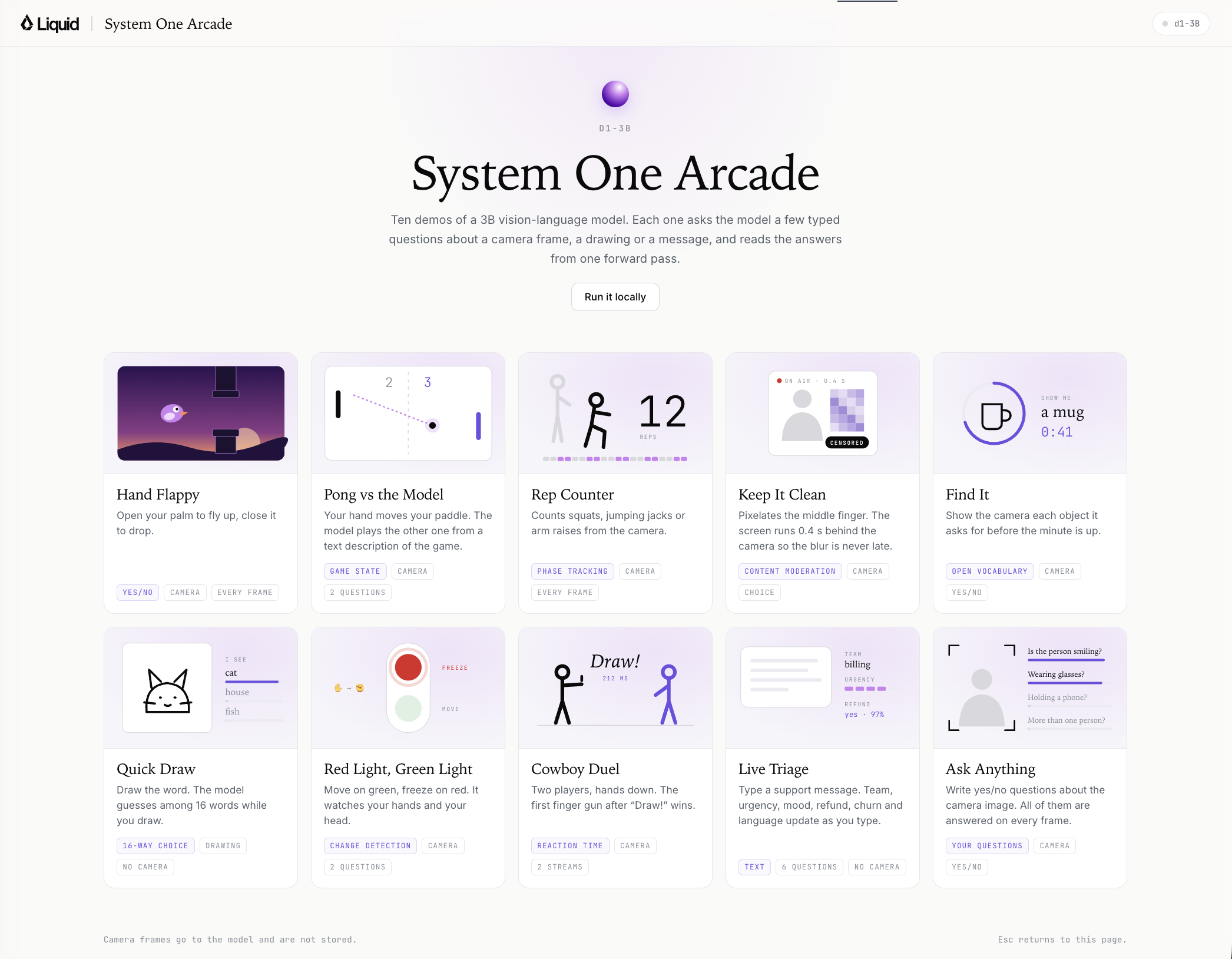
The interesting part is not the benchmark gap but the interface. If a routing decision, a moderation flag or a safety check can be read straight from a distribution, the parsing step — and the latency and failure modes that come with generating and then matching text — disappears. The sub-10 ms GPU numbers are fast enough to sit inside a live video loop, which is what Liquid’s ten-demo System One Arcade shows.
The trade-off is flexibility: the decision structure must be authored up front, and the model cannot explain itself in prose. Evaluation is also thinner than the marketing suggests — Liquid scored its own models, and no vision or audio decision benchmarks exist yet. And the LFM Open License v1.0 permits free commercial use only below $10 million in annual revenue, leaving the hosted d1 API as a separate, proprietary product for larger organisations. For a first open release in a new model class, though, the pair is a concrete artifact: weights, deployment guides and a browser demo are all available today.
Related Coverage
- Liquid AI’s LFM2-VL-450M: Vision-Language AI in Half a Billion Parameters — earlier RITS coverage of Liquid’s compact multimodal models, whose vision tower reappears inside d1-omni-600M.
- TypeSafe AI Launches Jev, a Model That Returns Decisions, Not Text — the decision-model category that d1 is benchmarked against.
This post was drafted with AI assistance and reviewed by RITS staff.
Sources
- Liquid AI: “Open d1: Edge decision models for text, vision, and audio”, October 7, 2026
- Hugging Face: “Multimodal open d1 decision models for the edge”, October 7, 2026
- Liquid AI: d1-3B model card
- Liquid AI: d1-omni-600M model card
- Liquid AI: d1-3B-W8A8 (INT8) model card
- Liquid Docs: Decision Models
- NVIDIA Jetson AI Lab: d1-3B deployment guide
- MarkTechPost: Liquid AI Releases Open-Weight d1-3B and d1-omni-600M